
A Painted Past: Discovering the Masterpieces Inside St Teilo’s Church including an amazing "Doom Painting".
/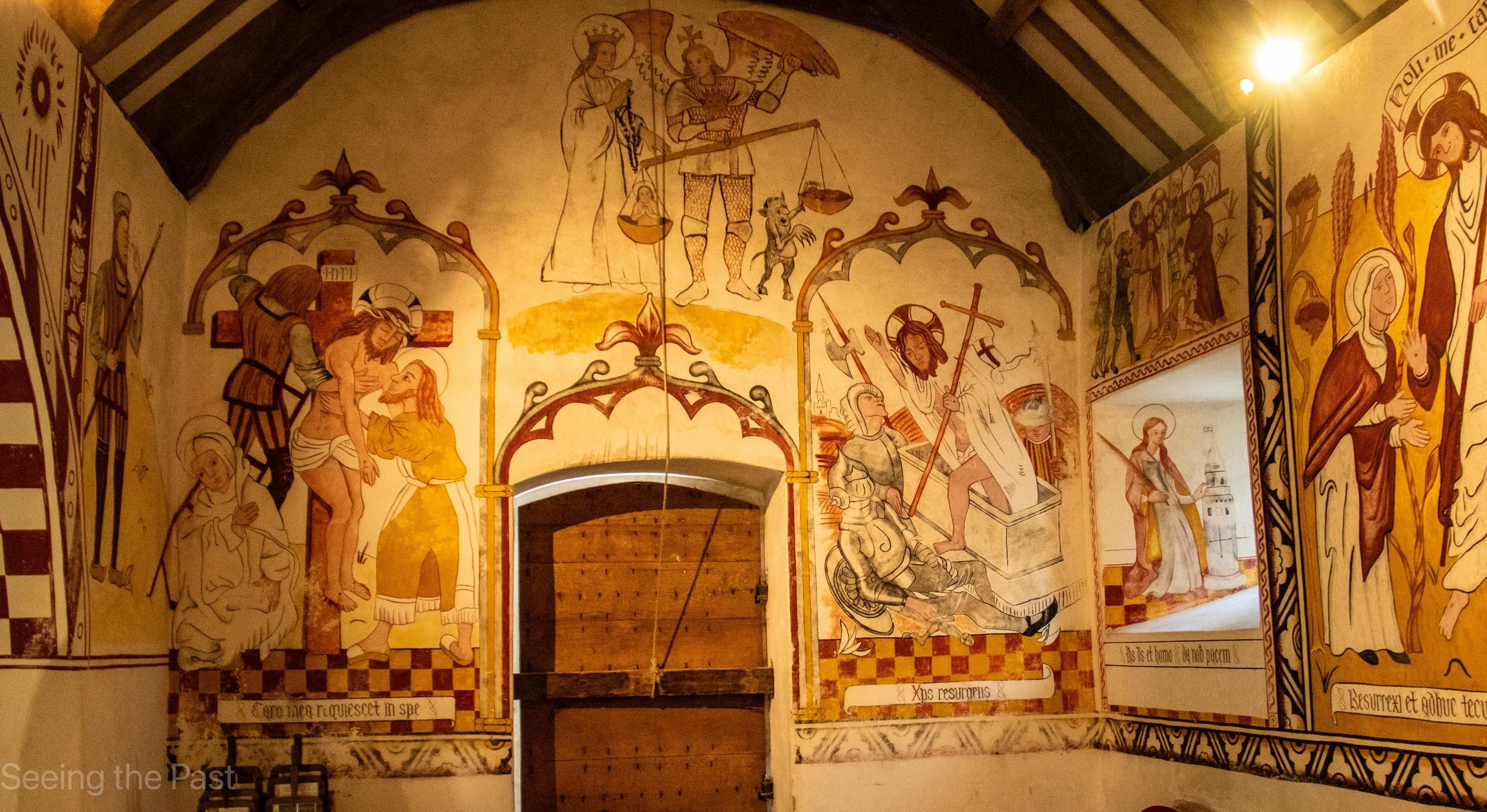
Visiting churches and cathedrals in the UK often gives the impression that they lacked colour except for their stained glass windows. The opposite however, was the case and a visit to the rebuilt St Teilo’s church will give a realistic view of what churches in the 16th century were like. When you enter the church you will probably be stunned by what you see. We have visited loads of churches and cathedrals, all with brown walls and the odd mural and doom painting but St Teilo’s will give you what people saw before the Reformation of the 1530s. It is hard to believe it but all those abbeys in the UK which today, are in ruins, were full of murals with vibrant colours.
St Teilo’s Church, now lovingly re-erected within the open-air precinct of St Fagan’s Museum of Welsh Life, is a remarkable testament to Wales’s medieval and 16th century heritage. Originally constructed in the early 16th century, this humble parish church was painstakingly dismantled, transported, and restored to its former glory — not least its dazzling wall paintings, which have been carefully recreated with scholarly precision. These vivid murals, brought back to life through meticulous craftsmanship, offer visitors a rare window into the devotional art and storytelling of the late medieval period. Stepping inside St Teilo’s, you’re transported back half a millennium, immersed in a world where faith, community, and artistic expression converged on plastered walls that still speak with vibrant colour and enduring power.
What can you see?
We love finding doom paintings and here is one albeit with unwelcome shadows. As is the norm with doom paintings, Jesus is in the middle and above the proceedings, making the decisions. Hell is on the right, gobbling up all the sinners and Heaven is on the left.
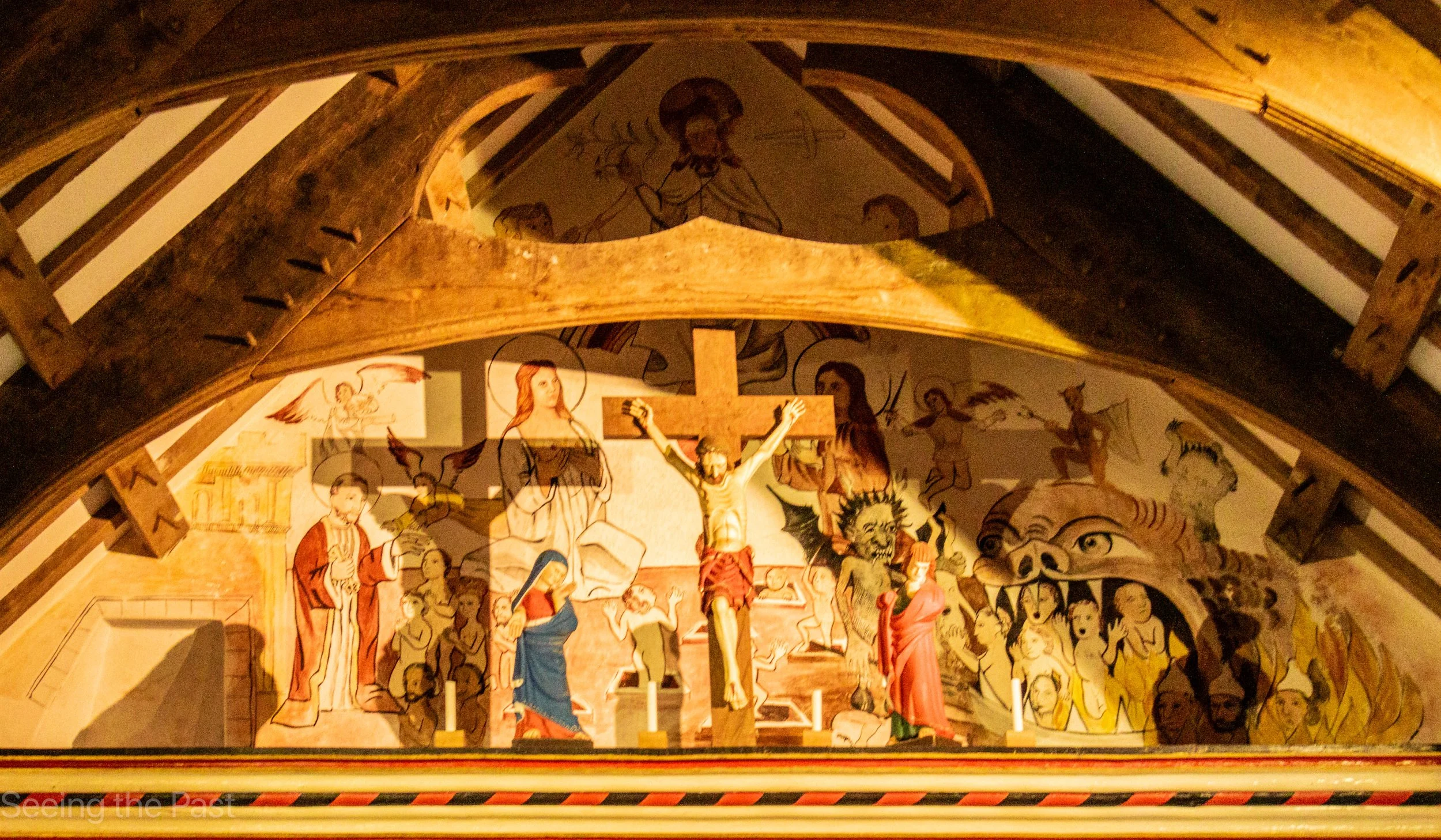
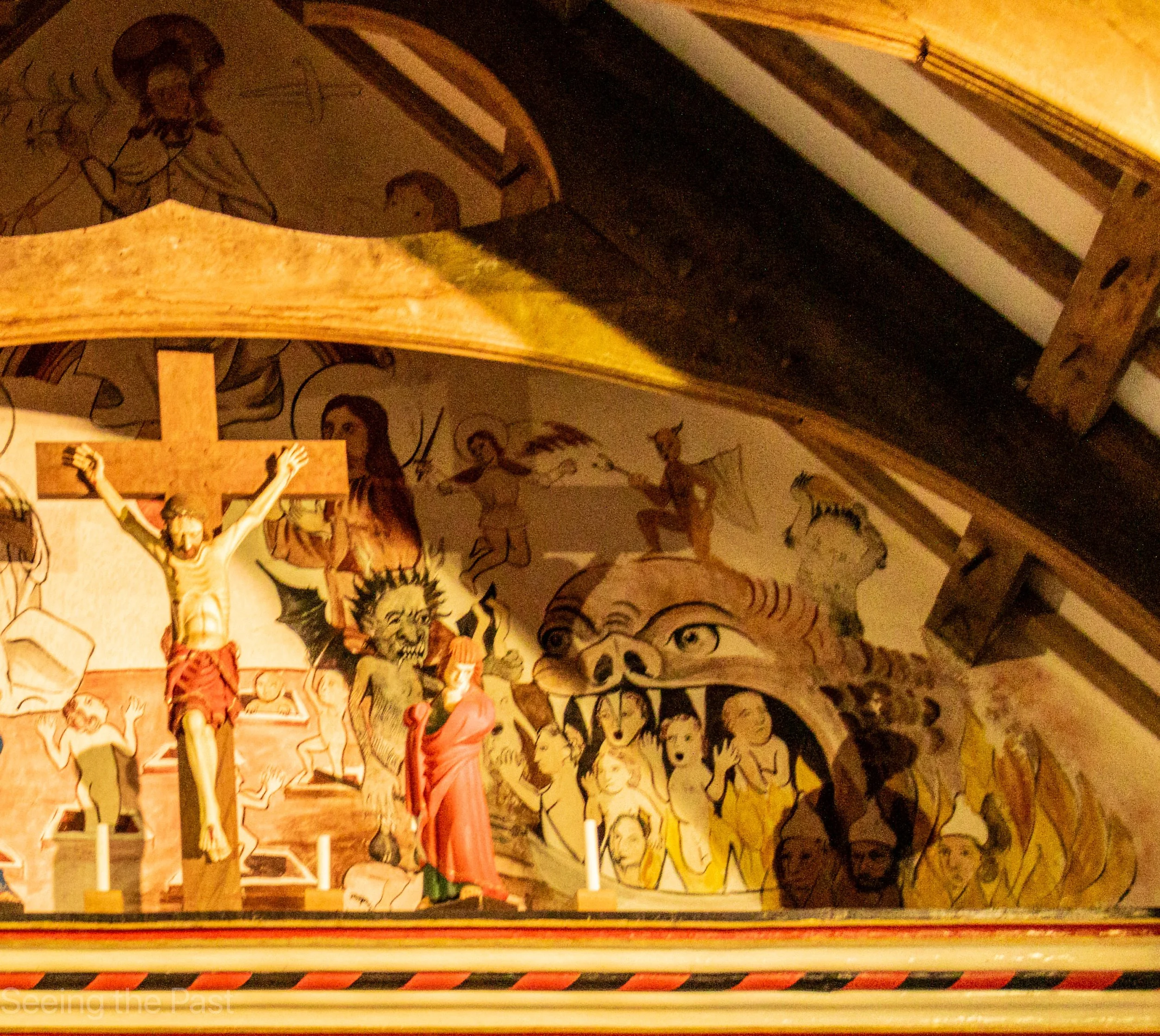
Below: a closeup of Hell. Imagine looking at that every sunday from an early age. I would have thought most people would have got the message to be good. Around Jesus being crucified, are souls rising out of their graves to be “judged”. To the right of Jesus is a statue of St Teilo.
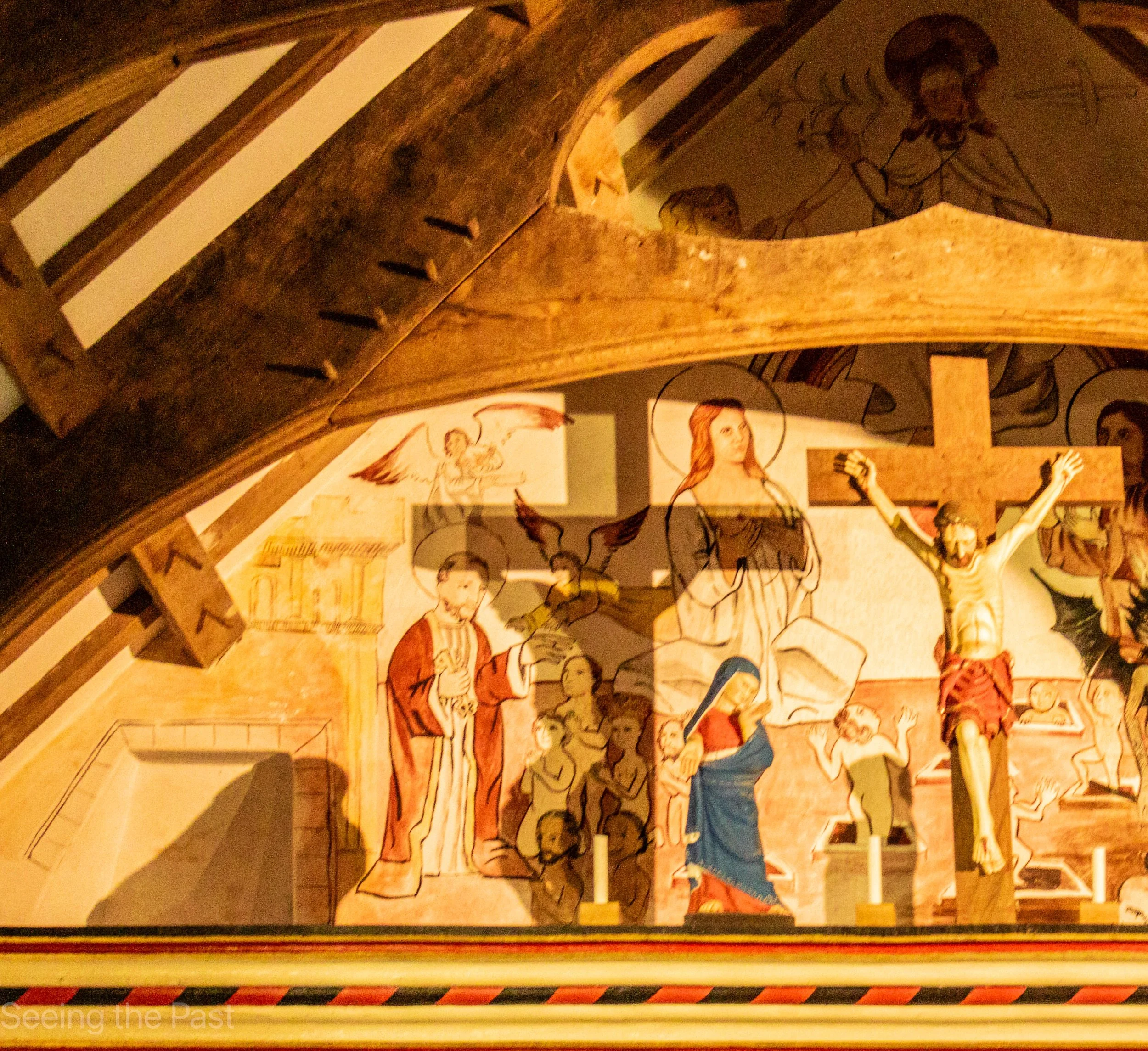
Below: the left half of the doom painting. St Peter is on the left with a key in his right hand to open the gates to heaven for these “good” souls. To the left of Jesus in blue, is a statue of the Virgin Mary.
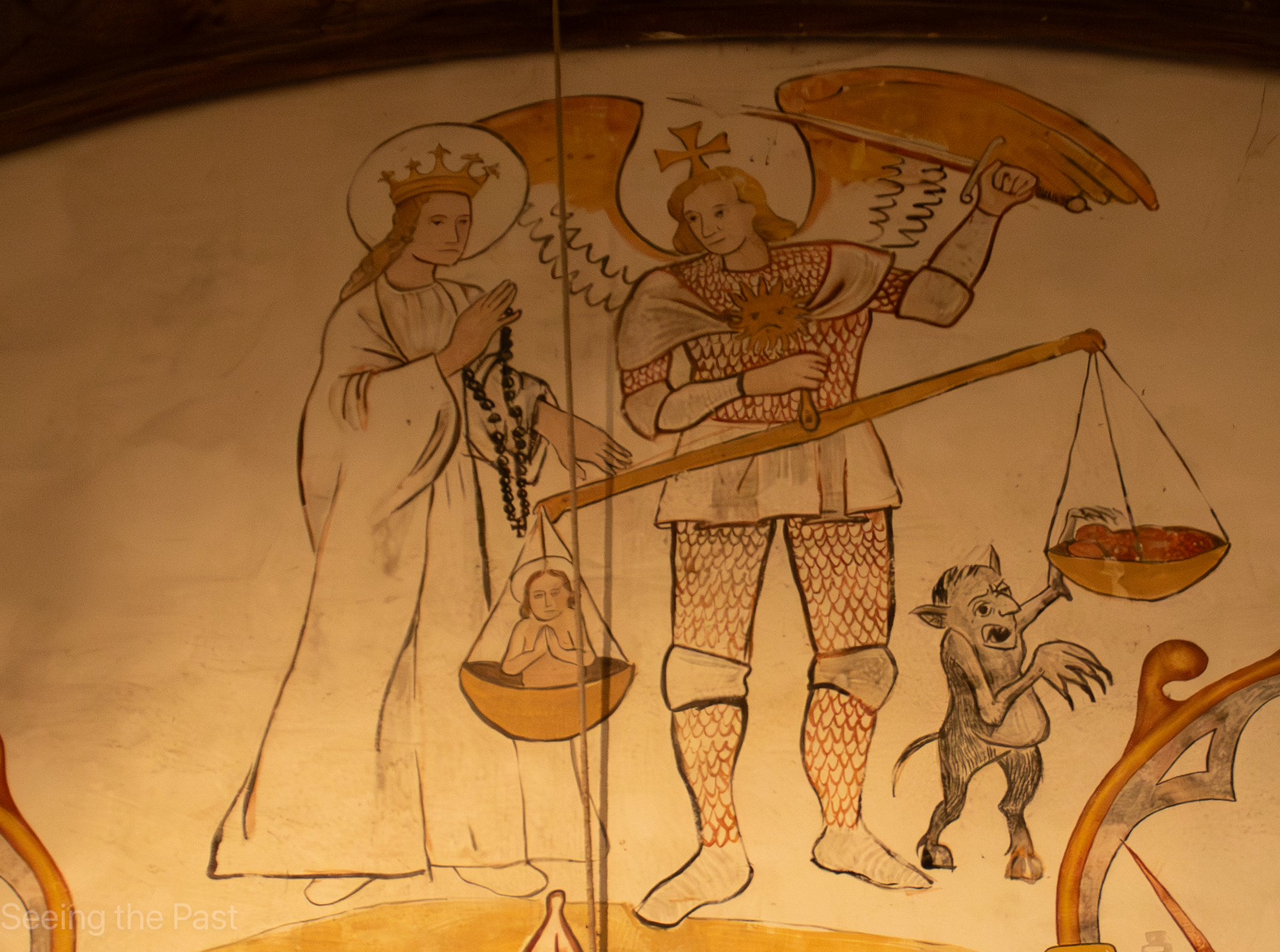
Below; the message is enhanced in this painting with the Archangel Michael holding a set of scales to weigh souls. On the right, as is often portrayed is a devil’s helper trying to push the sales down so that this soul ends up as being judged a sinner and therefore is sent to Hell.
Below:
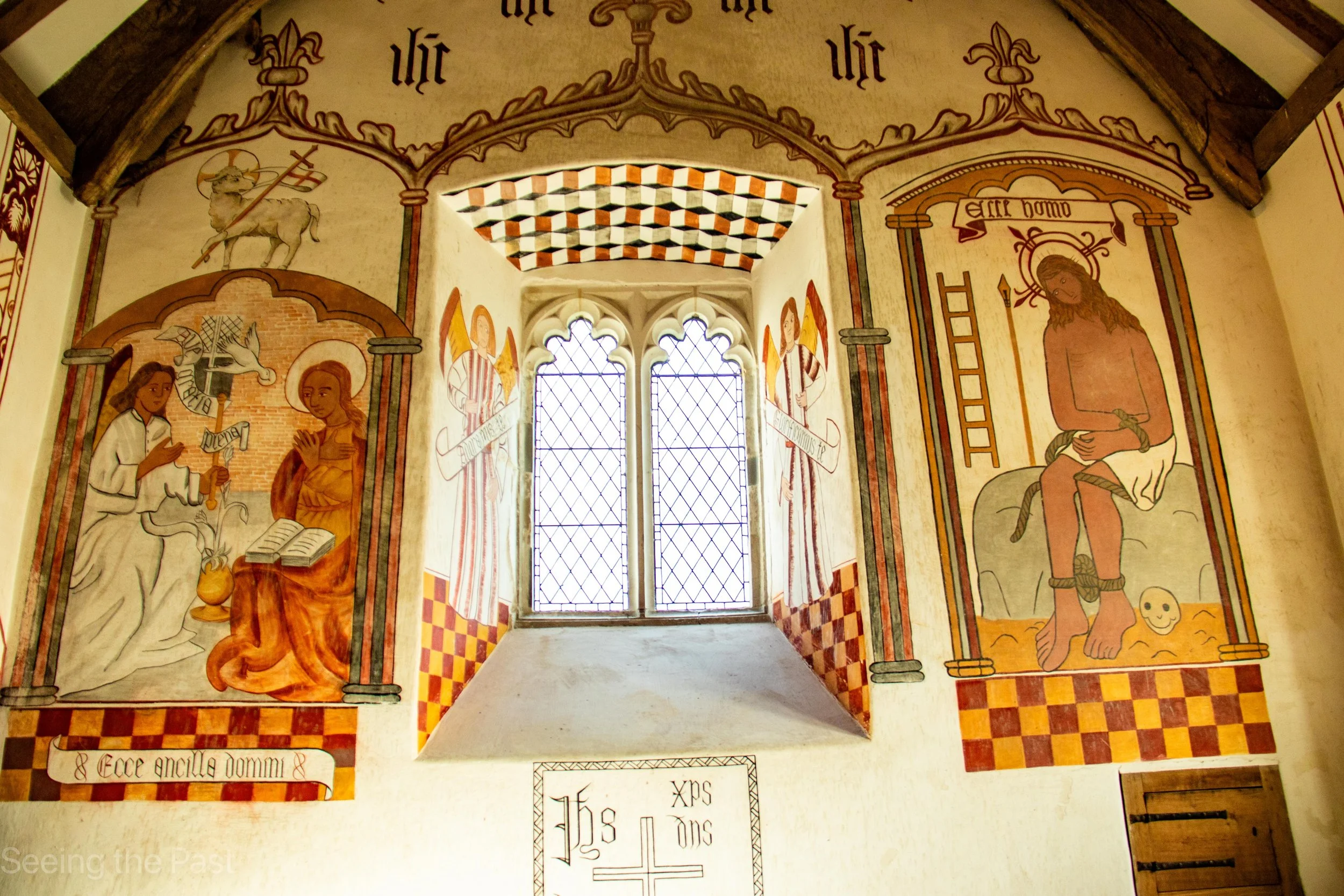
On the left the Angel Gabrielle in white is announcing to the Virgin Mary that she will give birth to the “Son of God” , Jesus. This is called “The Annunciation”.
On the right we believe this is Jesus imprisoned before his crucifixion.
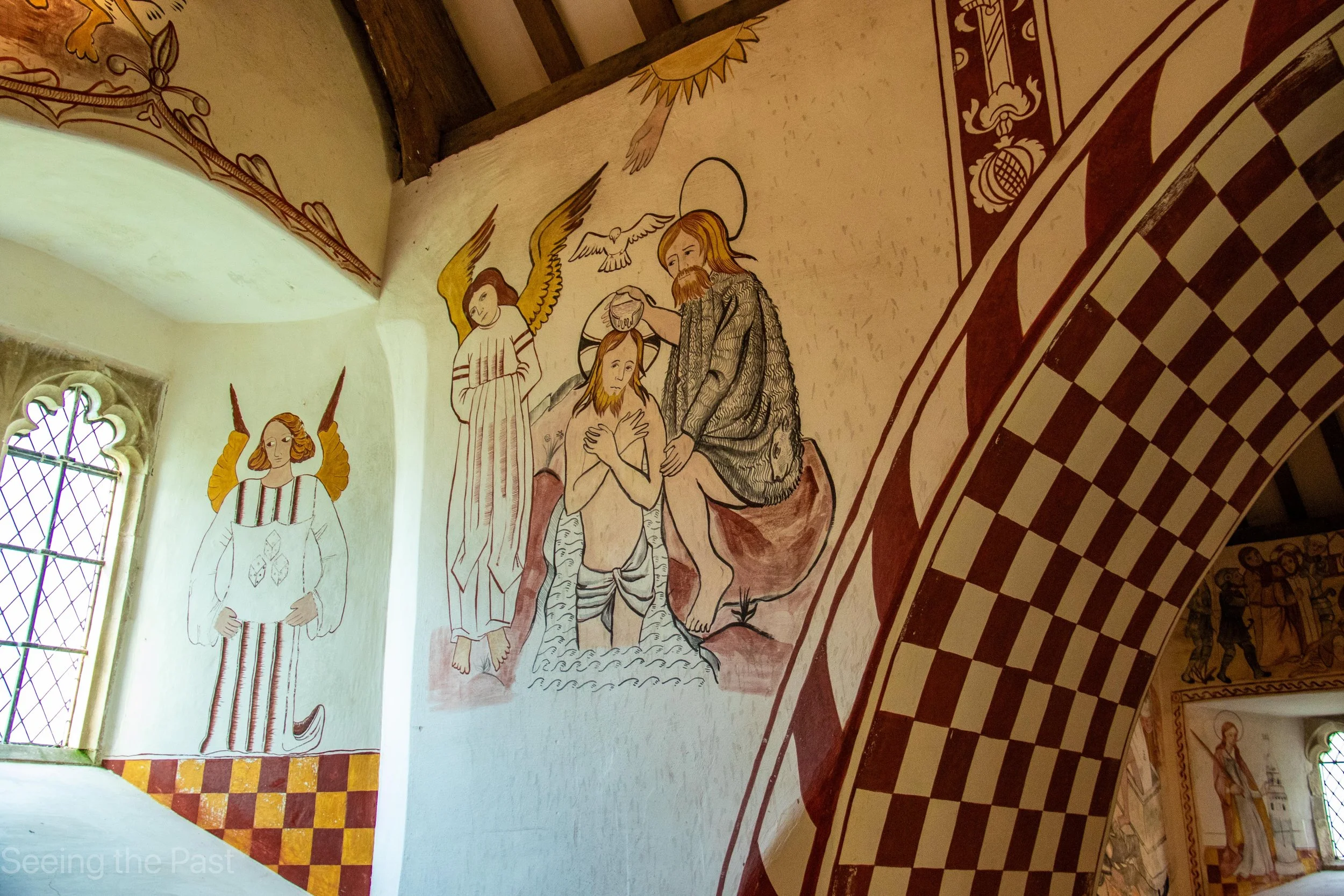
Below: John the Baptist is Baptising Jesus in the River Jordan before he started his public Ministry. The Holy Spirit descended in the form of a dove and a voice from heaven stated that Jesus was his beloved son. This is recorded in the synoptic gospels (Matthew, Mark and Luke).
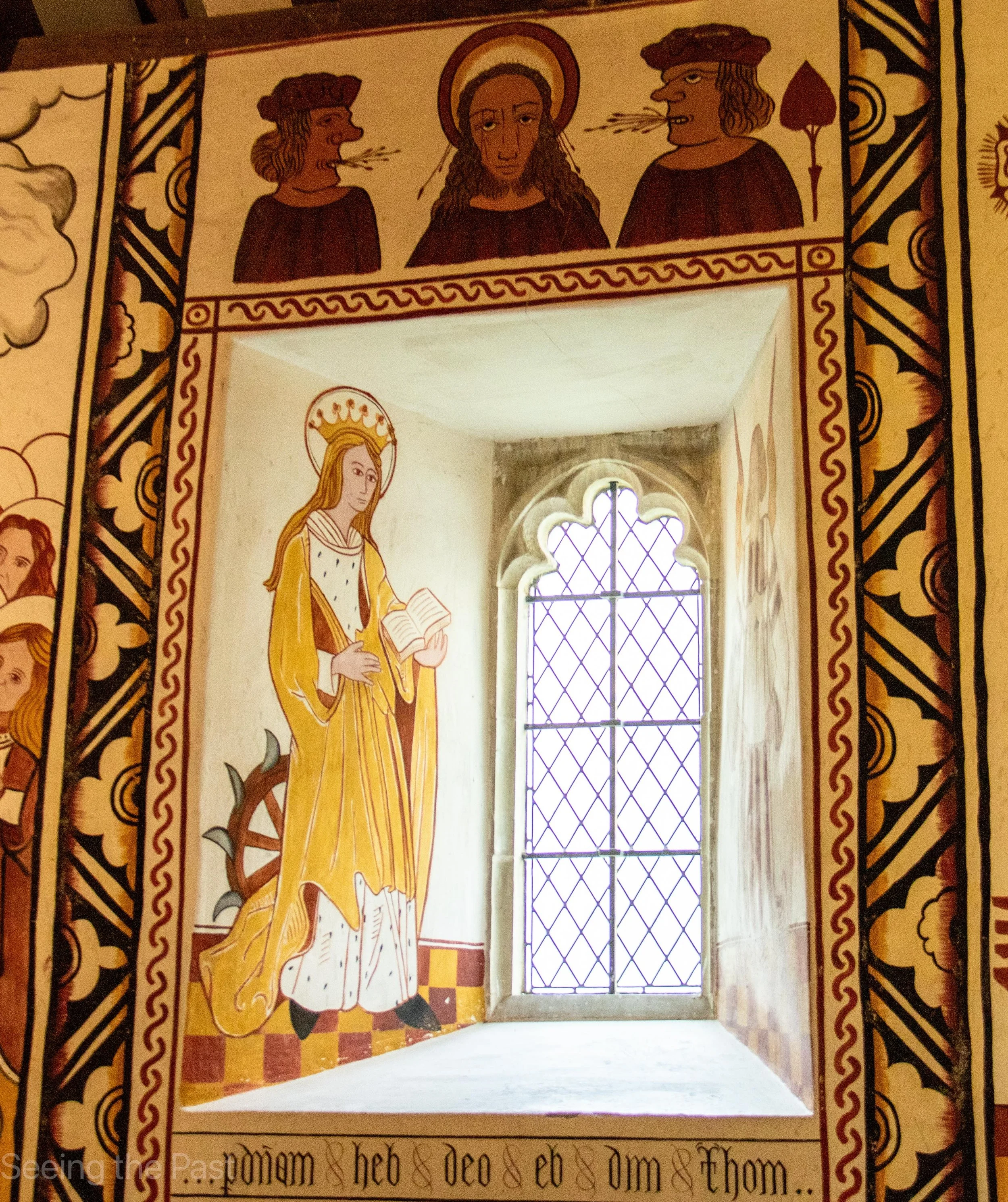
Below: this depicts “The Humiliation of Christ” in which he is rejected and humbled so that his suffering will give him humility that God desires in his people. Next to the window is St Catherine and a symbolic wheel that represents the way she was tortured and was meant to die. We use the word meant because miraculously, the wheel shattered when she touched it and so she had to be beheaded with a sword.
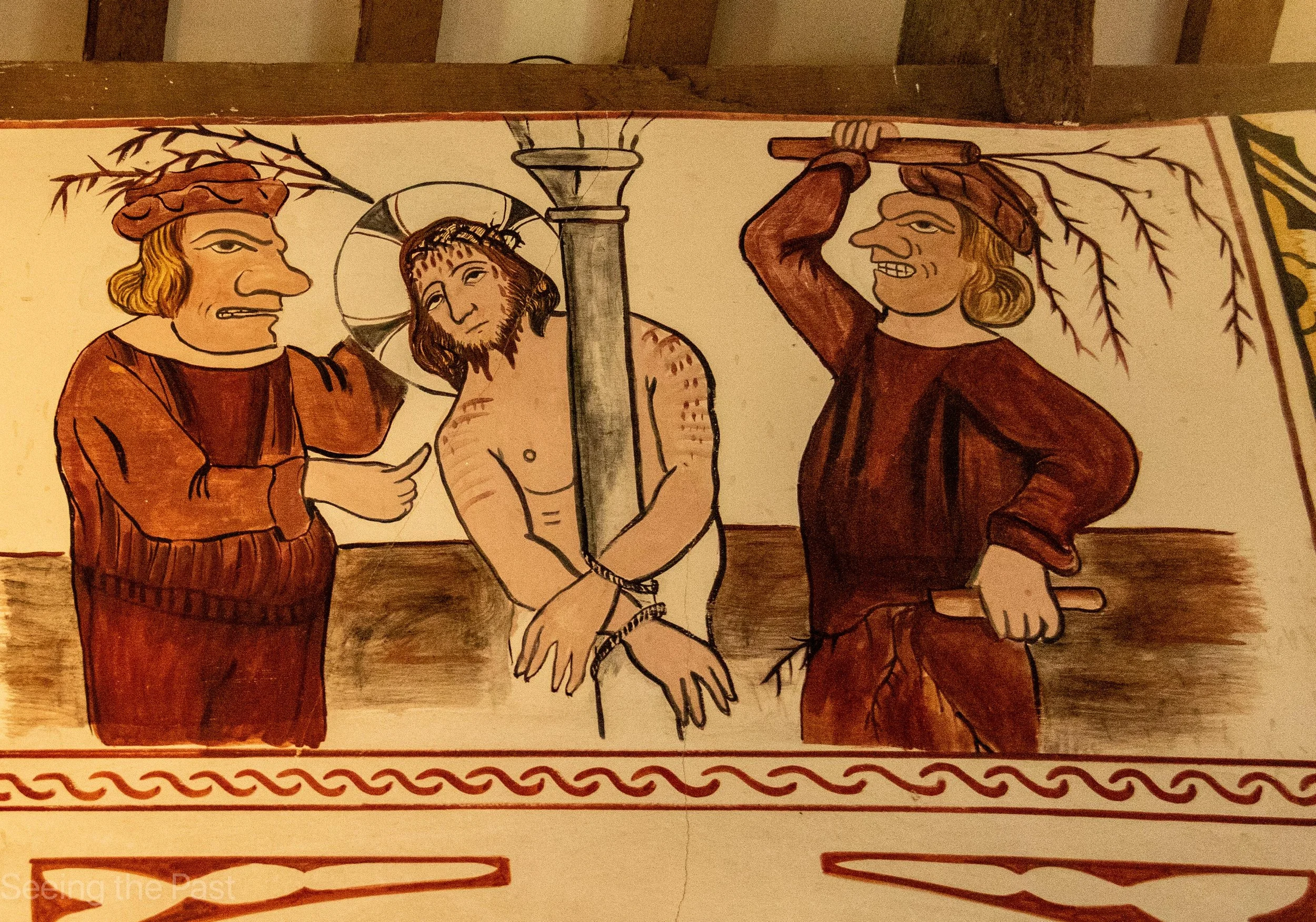
Below: More humiliation of Jesus in which he is scourged.
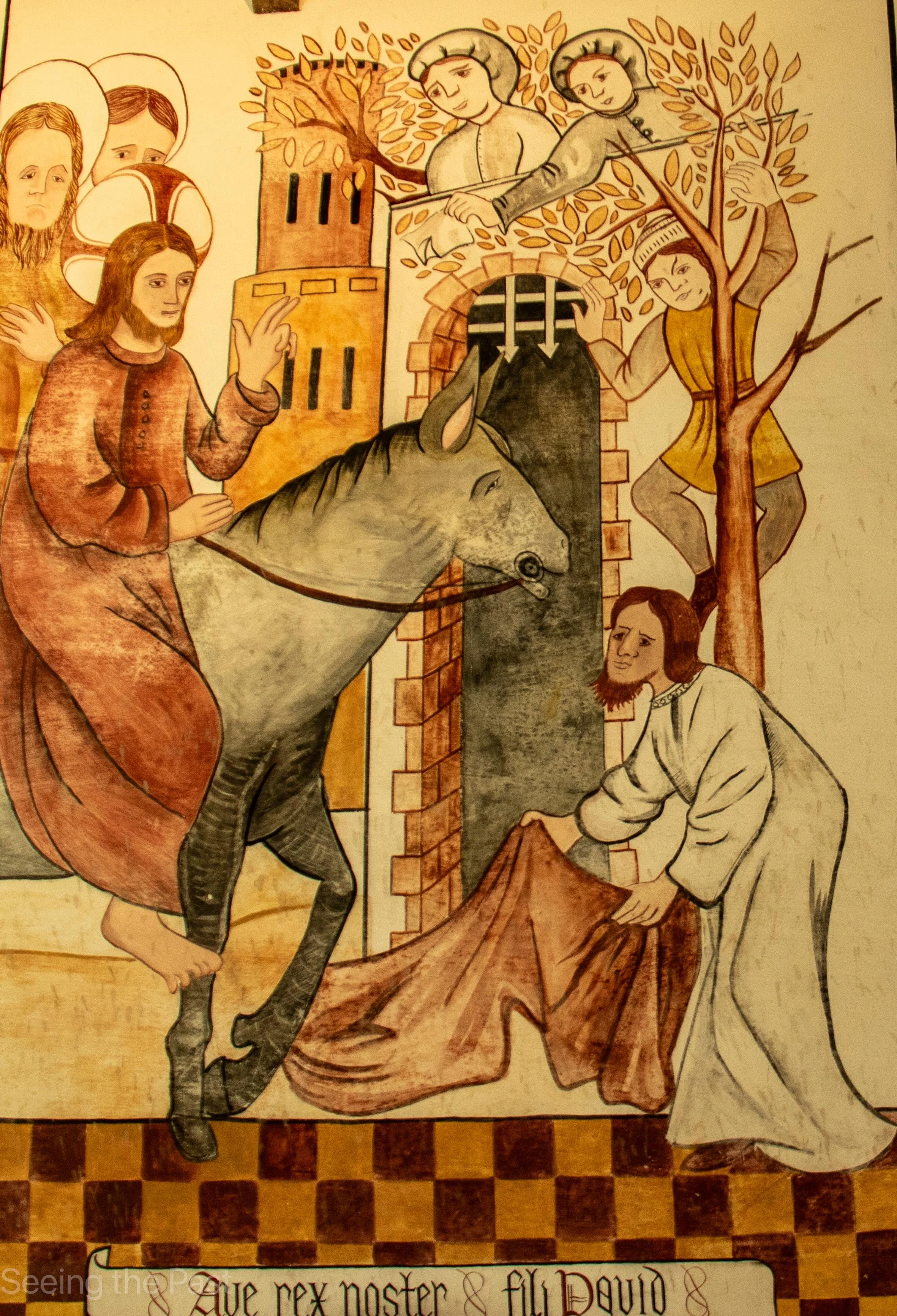
Below: Jesus is riding triumphantly into Jerusalem on a donkey. Christians call this event “Palm Sunday” because the crowds cheered and laid palm branches and their coats on the road before him.
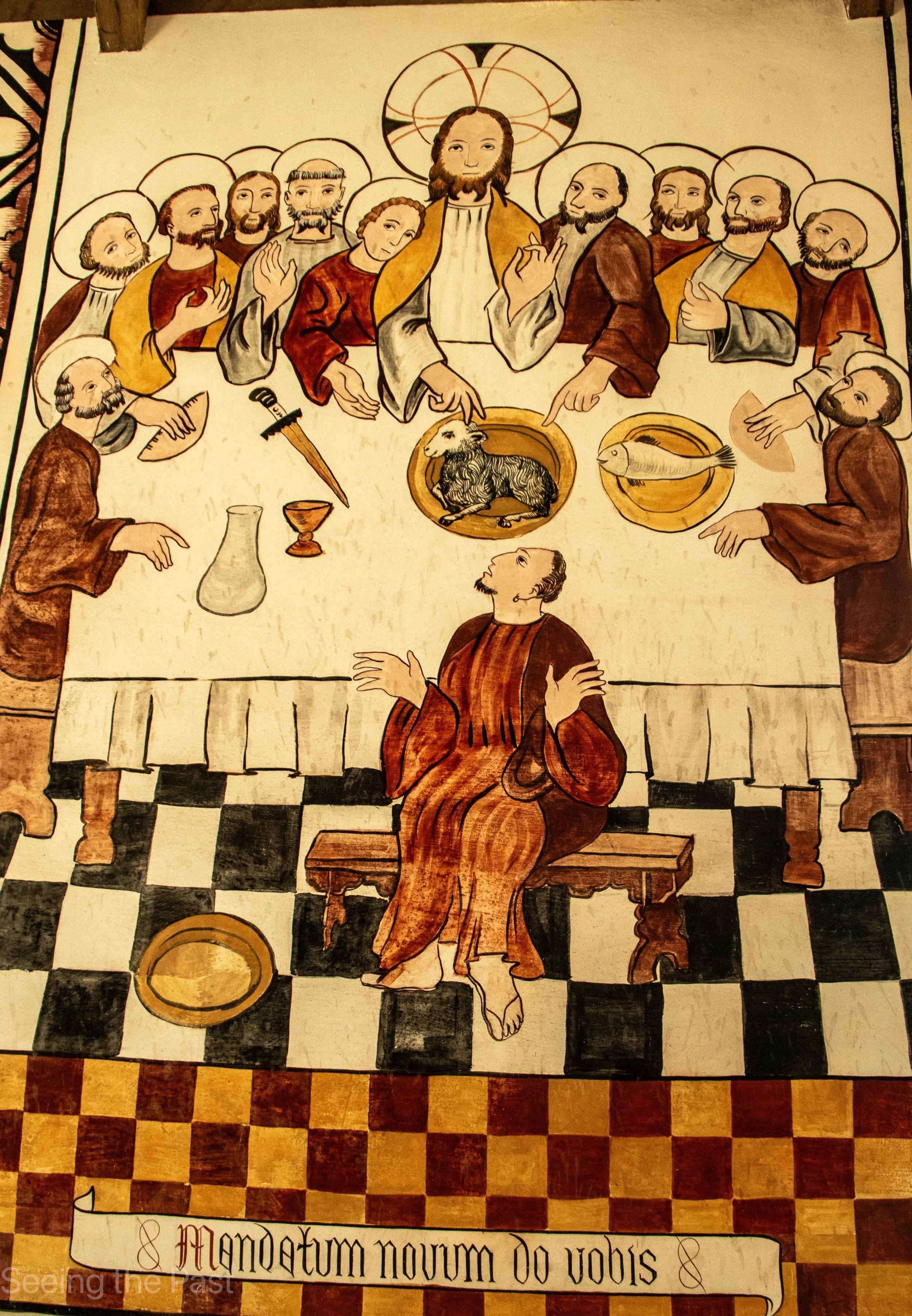
Below; “The Last Supper” - Jesus’ final meal with his 12 disciples in which they celebrated the ‘Passover’. During the meal, Jesus stated that one of his disciples would betray him.
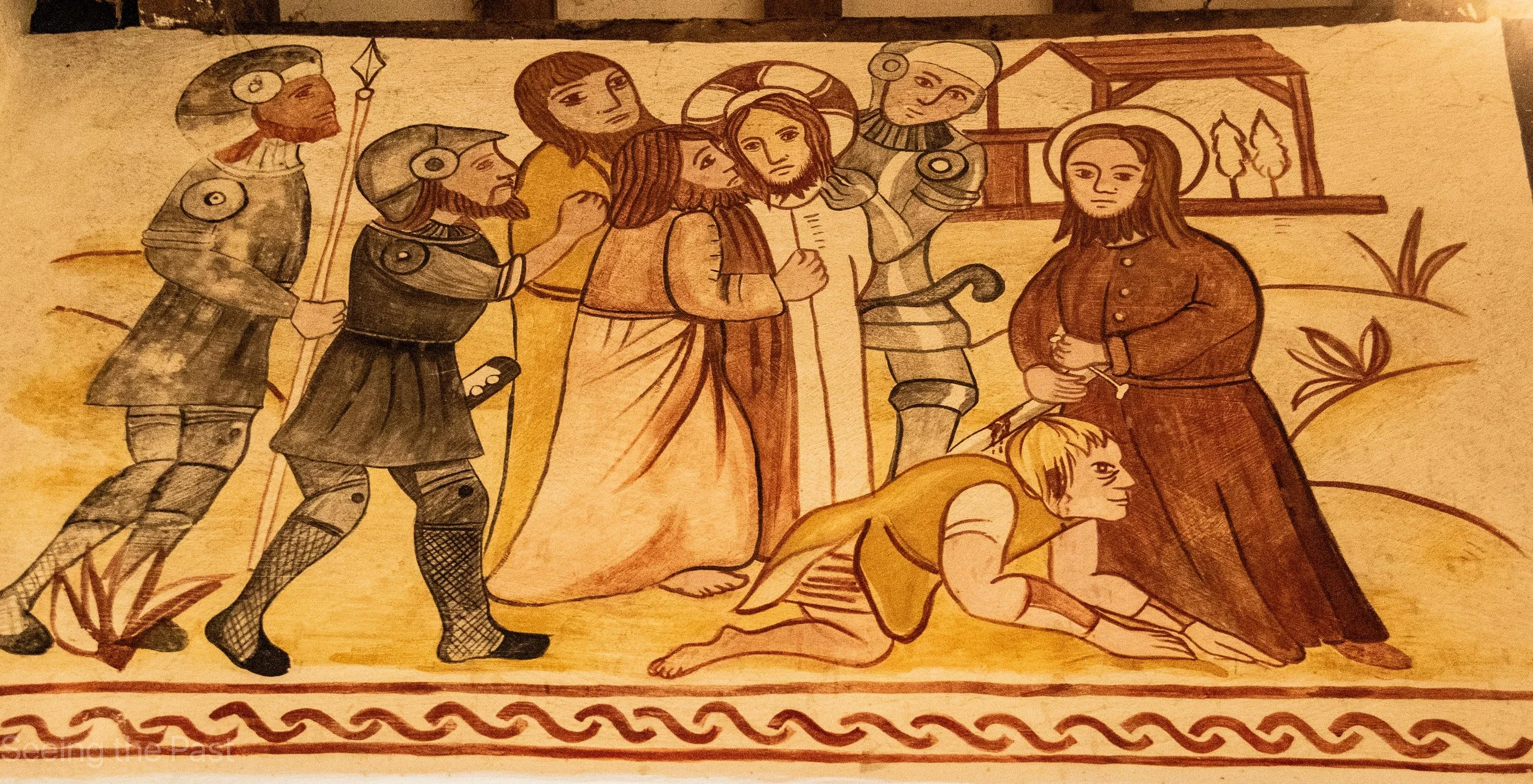
Below: Jesus is arrested in the garden of Gethsemane. Judas betrayed Jesus by kissing him. This indicated to the guards who Jesus was so that they knew who to arrest.
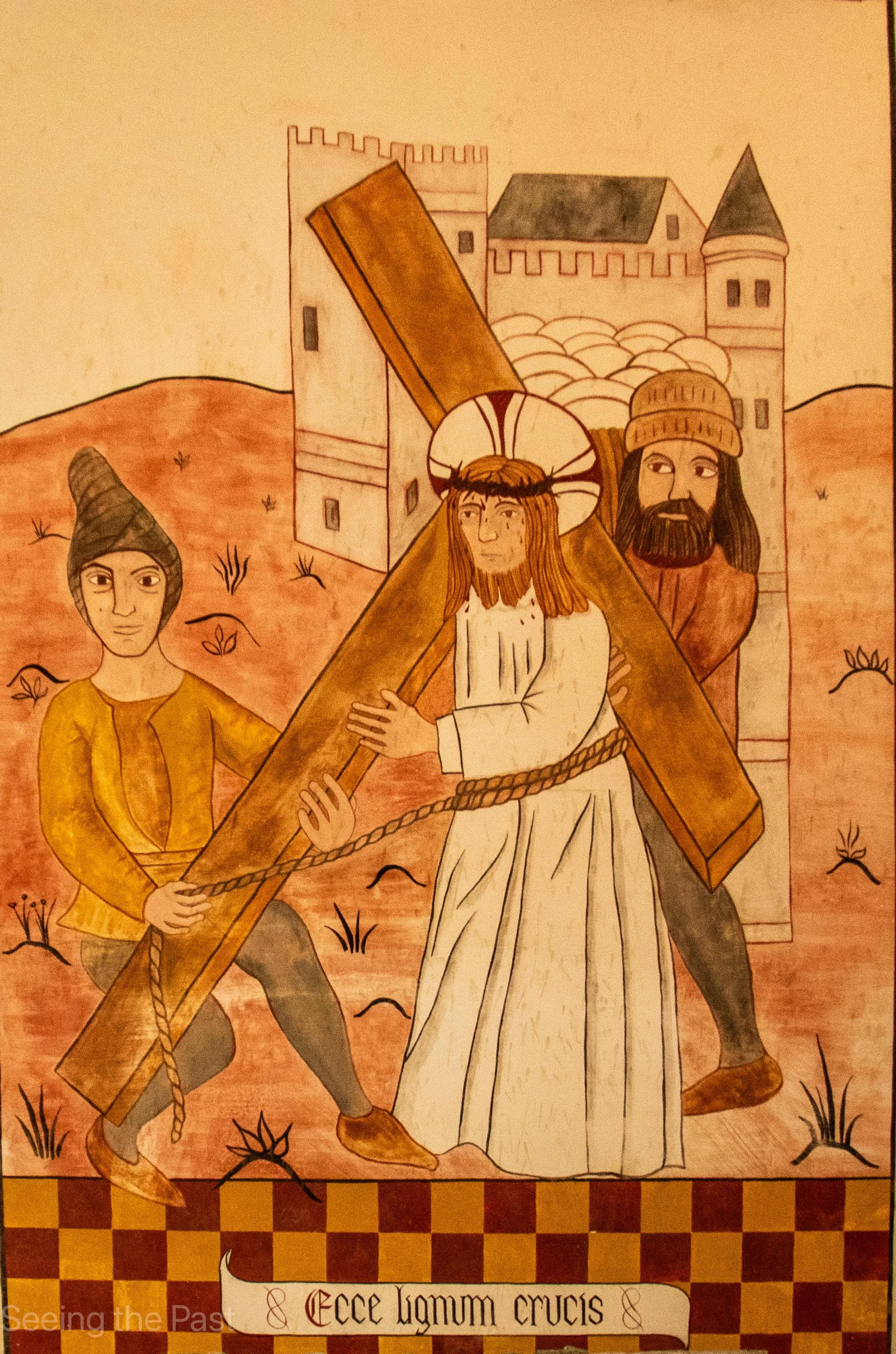
Below: This shows that Jesus had to carry his cross on which he was to be crucified.
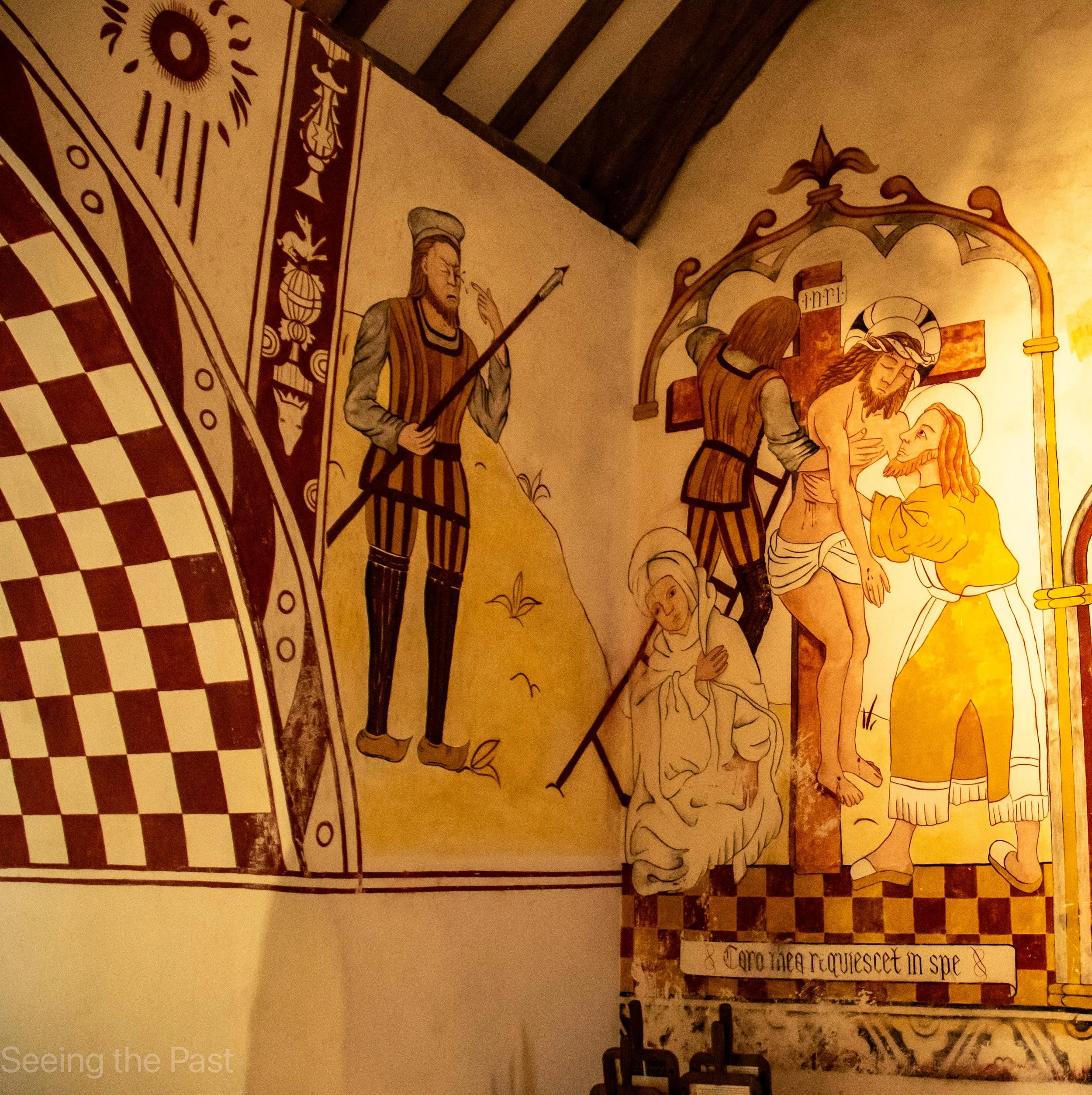
Below: In this painting Jesus is taken down from the cross after he had died by Joseph of Arimathea and Nicodemus. They put Jesus’ body in a shroud and placed it in a nearby tomb. Mary Magdalene was present also.
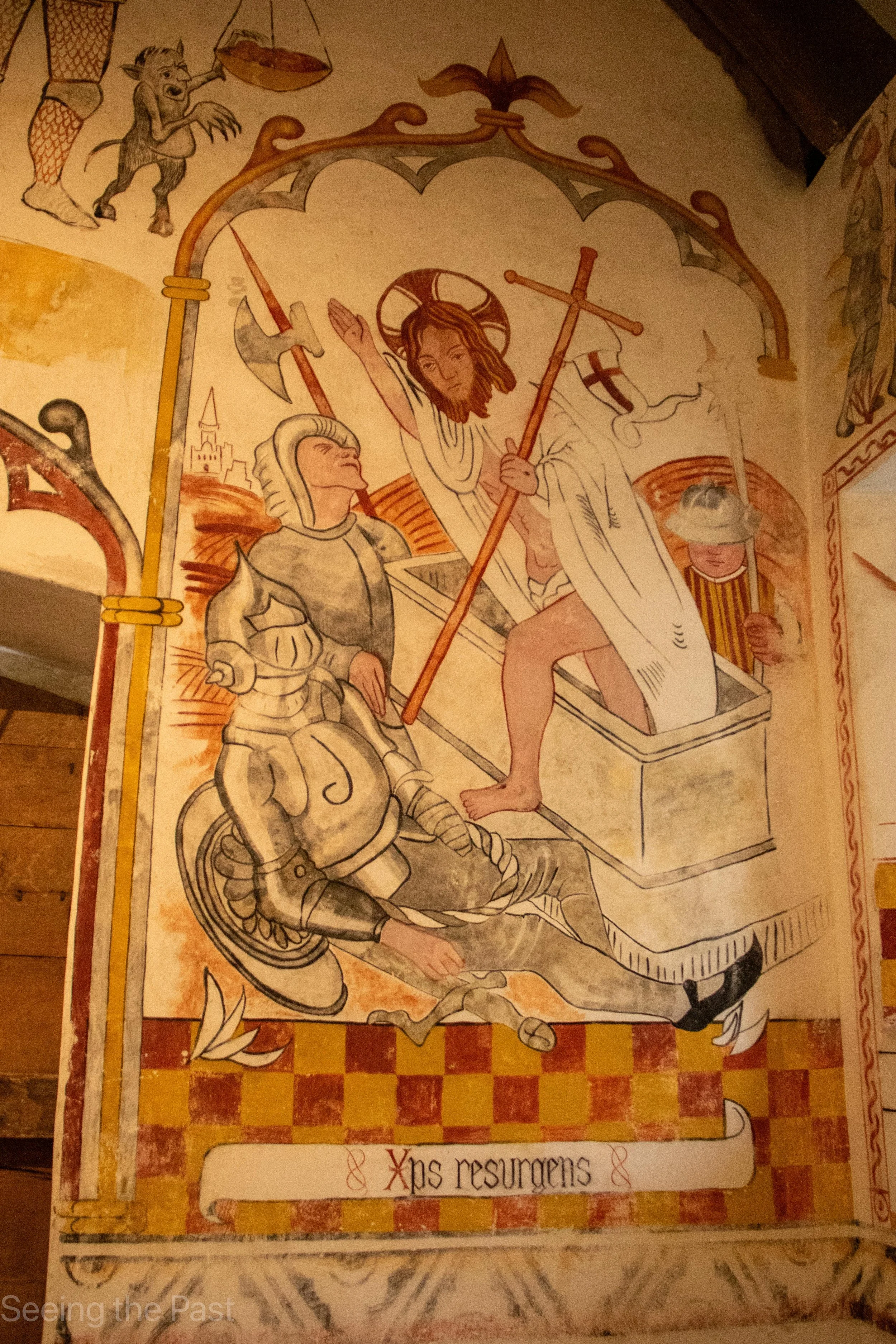
Below: The resurrection in which Jesus rose from the dead from the tomb he had been placed in.
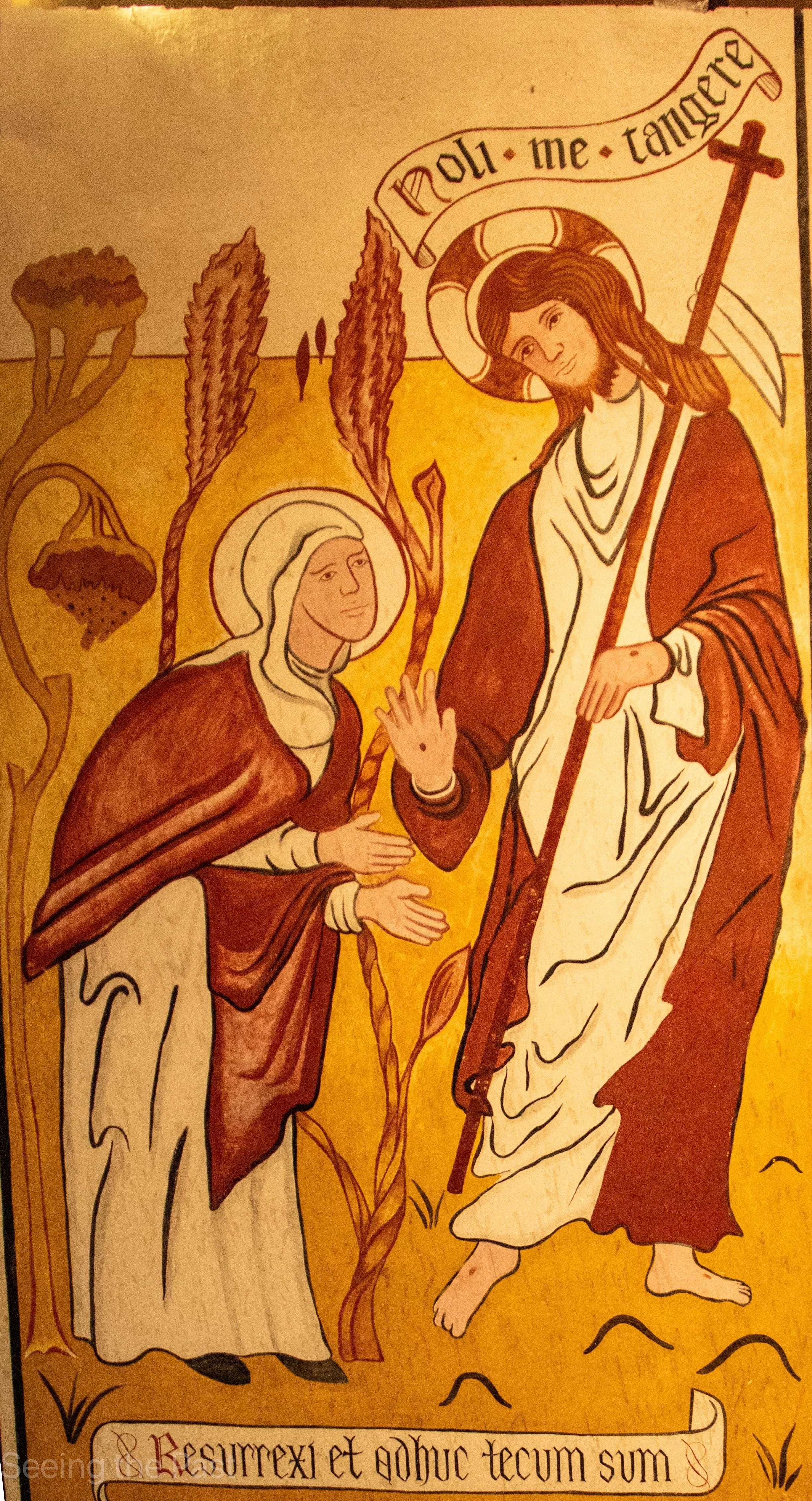
Below: Jesus is alive and meets Mary Magdalene but asks her not to touch him. The dots on his hands represent nail holes known as “stigmata”. In fact the nails went through his wrists and not his hands, in order to support his body so that he might die painfully and slowly.
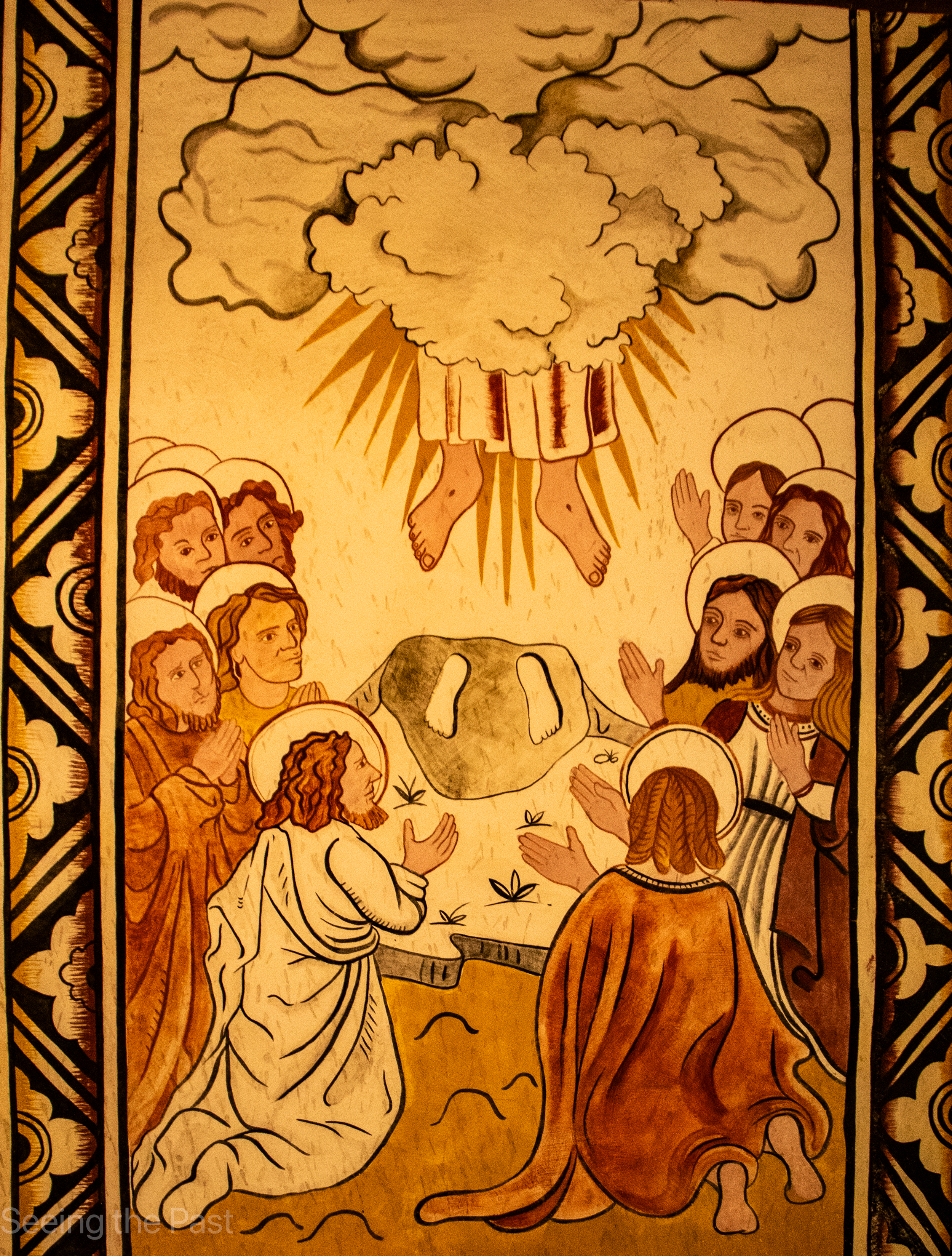
Below: The Ascension of Jesus in which he was lifted through the clouds and up to Heaven 40 days after his resurrection. This occurred on the Mount of Olives near to Jerusalem.
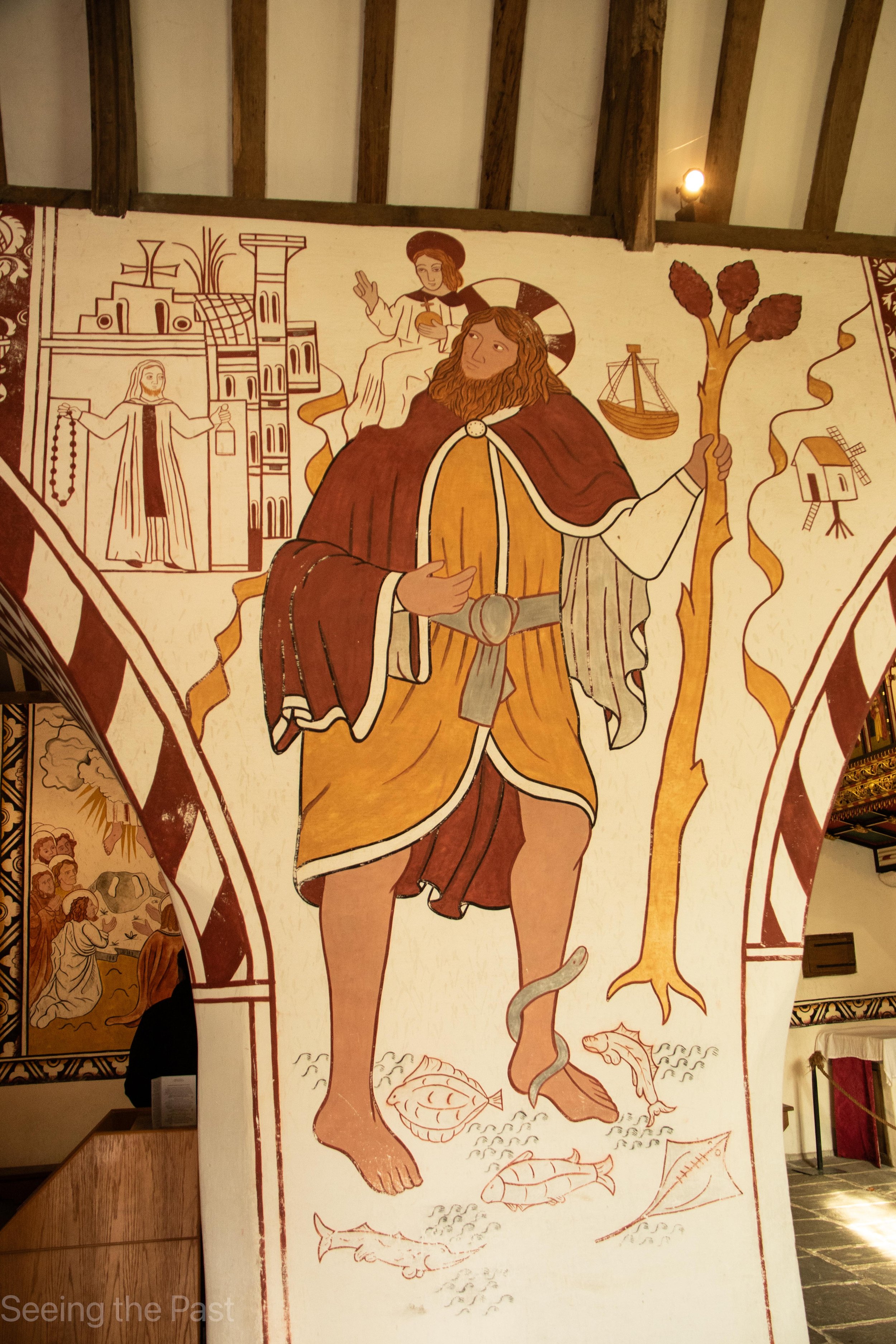
Below: St Christopher with Jesus on his shoulders. Legend has it that St Christopher was a giant who carried Jesus, in the form of child. across a dangerous river. Hence he is the patron saint of travellers and pilgrims.
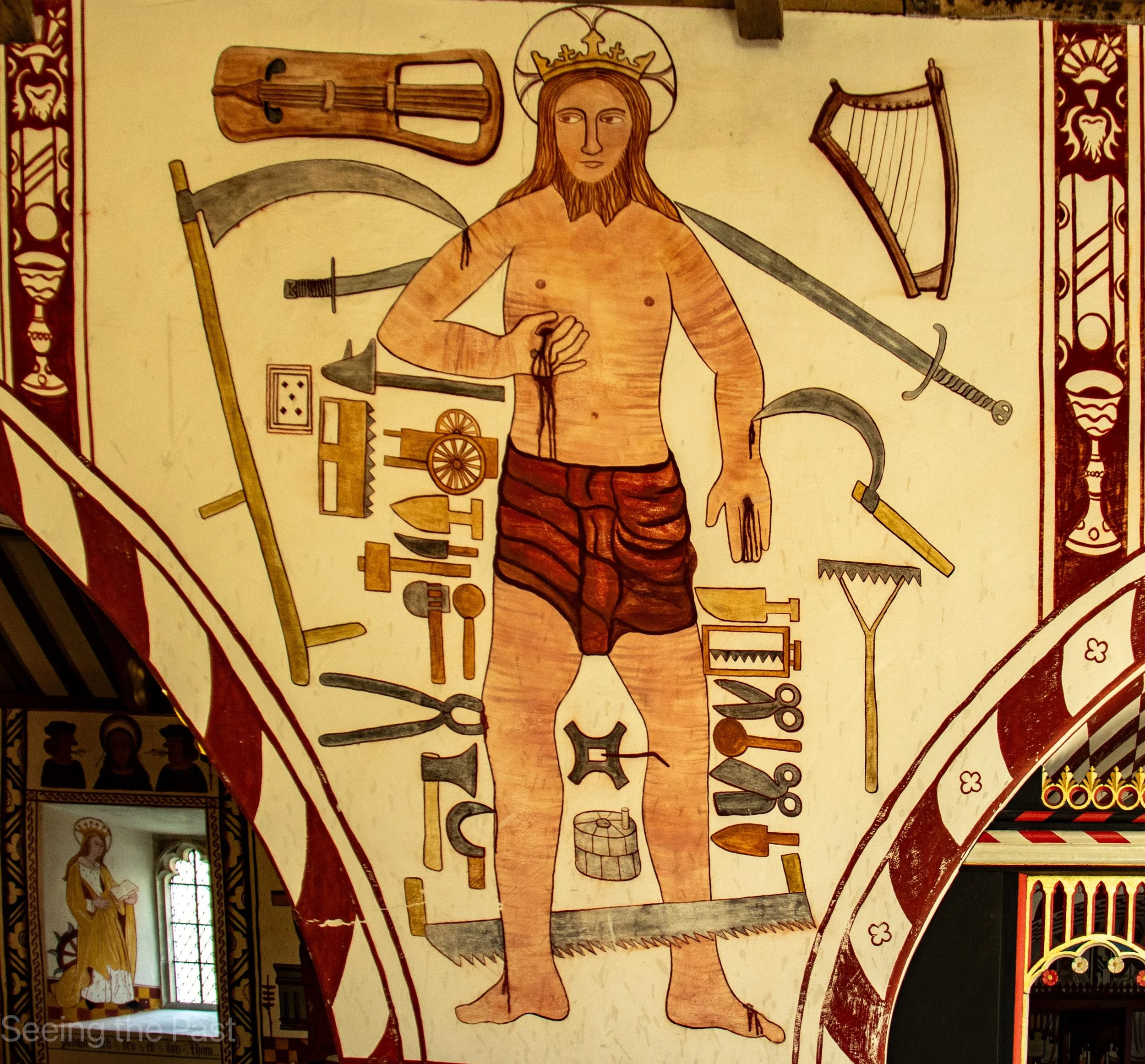
Below; Jesus with a carpenter’s tools. His earthly father, Joseph, was a carpenter and it is likely that Jesus would assist Joseph in his workshop.
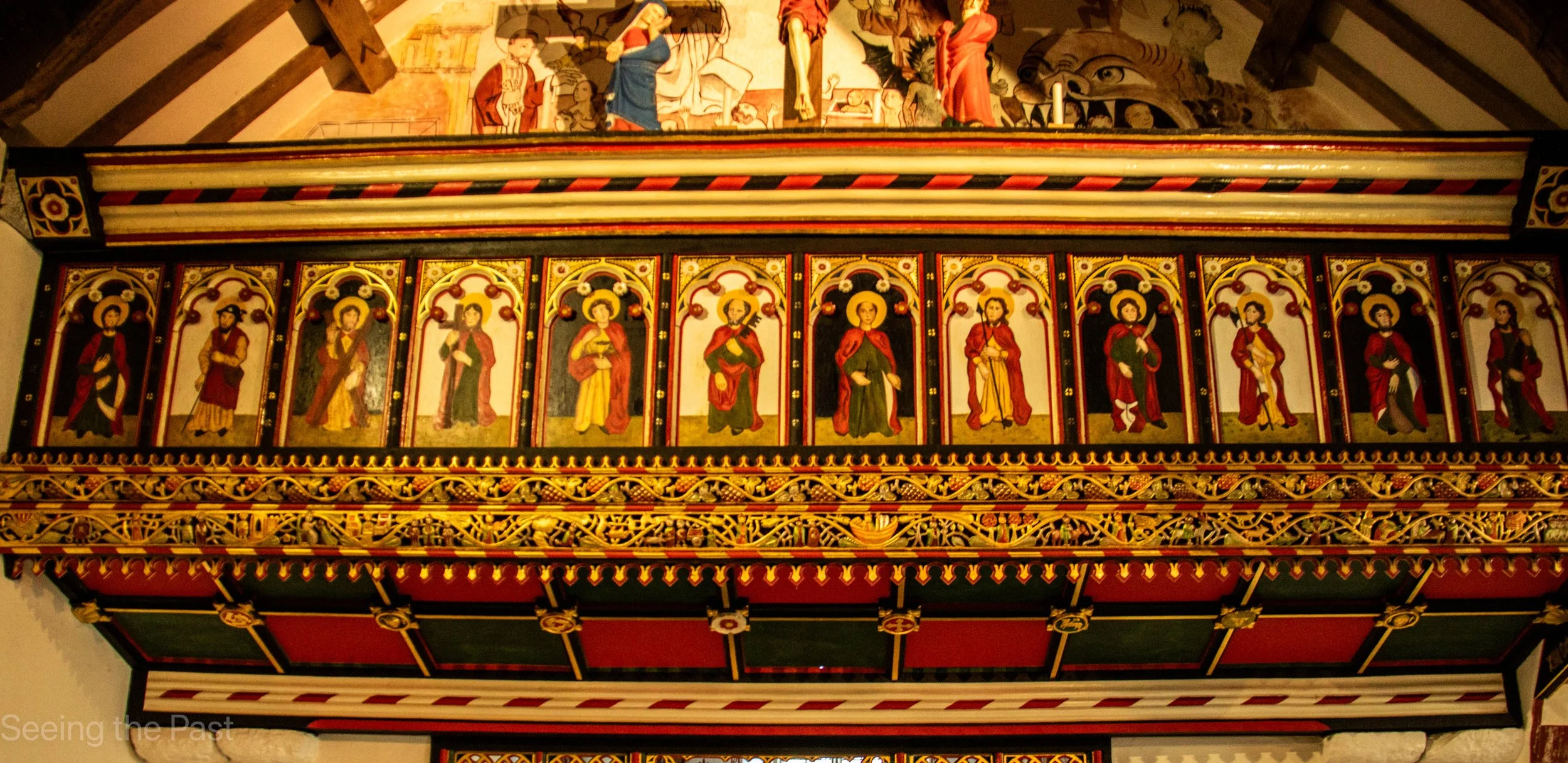
Below:the “Rood Loft”. Below the panels featuring the Apostles, are two “vine trails”, the bottom of which has scenes from the life of St Teilo. This was not original but a modern recreation of what one might have seen in this space based on research in Wales and Brittany.
Essential information.
Click here for information on getting to St Fagans.
Click here for opening hours etc
Articles that might interest you.





St Teilo’s Church, now lovingly re-erected within the open-air precinct of St Fagan’s Museum of Welsh Life, is a remarkable testament to Wales’s medieval and 16th century heritage. Originally constructed in the early 16th century, this humble parish church was painstakingly dismantled, transported, and restored to its former glory — not least its dazzling wall paintings, which have been carefully recreated with scholarly precision. These vivid murals, brought back to life through meticulous craftsmanship, offer visitors a rare window into the devotional art and storytelling of the late medieval period. Stepping inside St Teilo’s, you’re transported back half a millennium, immersed in a world where faith, community, and artistic expression converged on plastered walls that still speak with vibrant colour and enduring power.