
A Medieval Masterpiece: The Extraordinary Wall Paintings of the church of St Peter and St Paul , Pickering.
/In the little town of Pickering, where the inhabitants are friendly and ready to help, you can find the beautiful church of St Peter and St Paul. Have a cup of coffee in one of the nearby establishments and prepare yourself to be stunned by the medieval religious art on a dramatic scale.
As you open the door you will be immediately faced with this huge image of St George slaying a dragon. I can write that this is simply magnificent. As a medieval child seeing every Sunday, the story of this amazing knight was exciting as well as totally believable. To the right is a huge painting of St Christopher, the patron saint of travellers who is usually opposite the entrance in medieval churches, to appeal to travellers and pilgrims as they enter. St Christopher was also asked to protect against “water, Tempest, Plague and “Sudden Death”. It was believed that anyone who saw an image of St Christopher would not die that day!
When were they created and what is the story behind the murals?
Experts have used the style of armour in the painting of the martyrdom of Archbishop Thomas Becket to date the murals to about 1470. However, like all of the surviving murals in churches today, the Reformation demanded that all Catholic images must be removed or at least covered in whitewash. Again, like many of the murals that can be seen today in the UK, they were rediscovered by the Victorians by sheer chance. In this case it was when a thick coat of plaster was removed and someone realised that a mural was underneath. However, the story of the murals took an unfortunate twist when the vicar of the church decided that he did not want “Catholic” images in his Anglican church and organised for them to be recovered, despite being instructed to leave them by an archbishop, who, in the church hierarchy, was far above the rank of the Reverend F Ponsonby. Fortunately, there were renovations in 1876 and the Reverend G H Lightfoot, took the opposite view to his predecessor (Rev. Ponsonby 1814-57) and had the whitewash removed again. Talking to the very knowledgable guide of the church, it was made clear to us that what we were seeing was the limited remains after two whitewashes and that some artists attempted, in good faith, to restore them by adding what they thought was missing. The guide showed us a book by Kate Giles from the University of York which included photos based on paintings of what was originally discovered and from that, it was clear to see what the guide had told us.
The question that everybody asks is who painted them?
Like all the other murals in this blog, no-one knows. Apparently, there were “jobbing mural painters” all over the country who would carefully paint them. They would go around from church to church producing murals and doom paintings and would move on to the next church, when all the job was finished.
What can you see here at St Peter’s and St Paul’s church, Pickering.
St George killing a dragon.
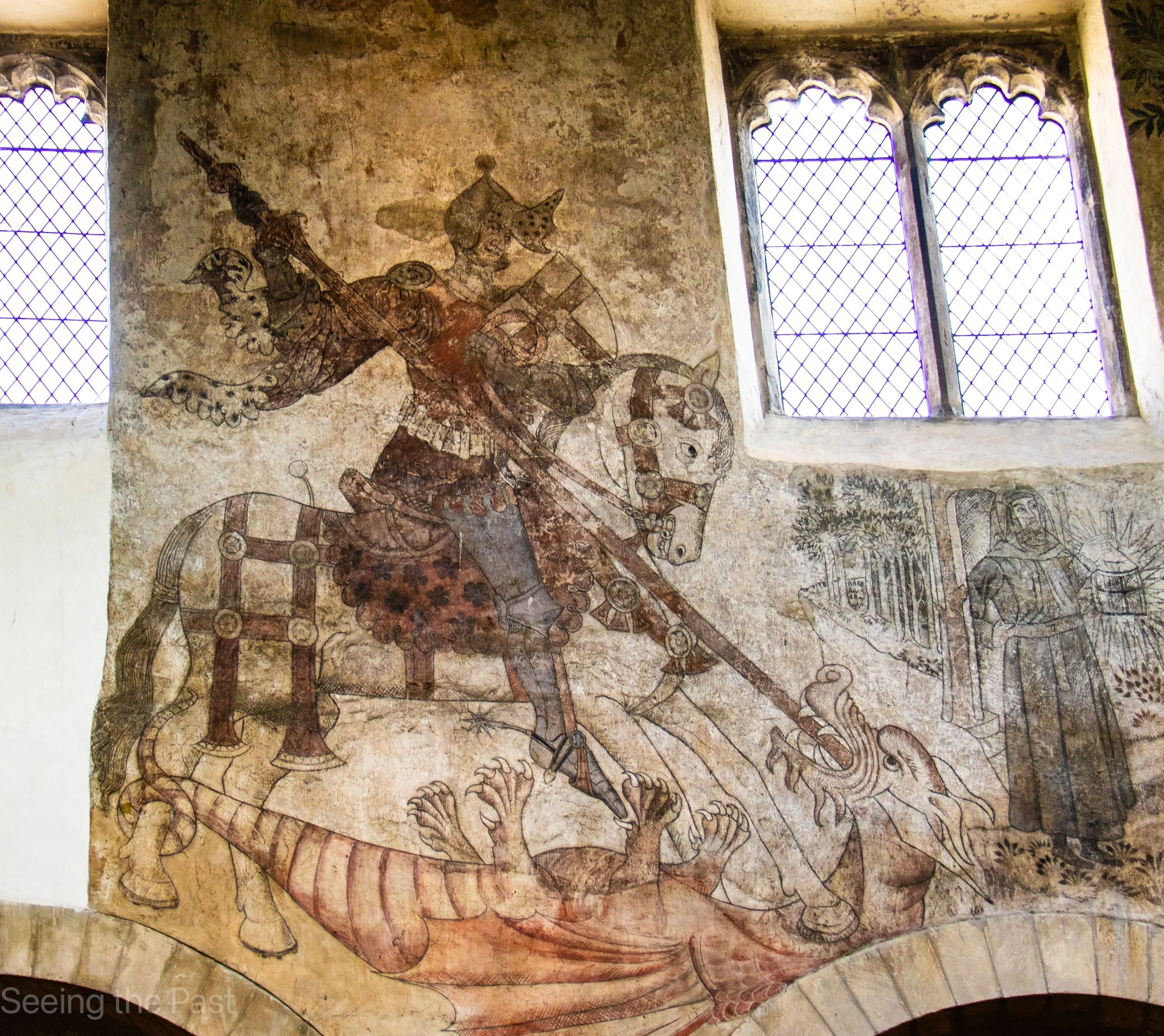
Who was St George?
He was an officer in the Roman army who was an ethnic Greek born in Cappodocia, which is in Anatolia, Turkey. He was not British and never visited Britain. He was born in about 280 AD, a long time before "knights in shining armour" using lances whilst on horseback. Unfortunately therefore, he couldn't have killed a dragon in the manner that he is usually portrayed. There is no mention of a dragon in the earliest records of his life known as hagiography.
How did St George become a saint?
He was, however, a Christian and as a consequence sentenced to death on April 23rd 303 AD for refusing to recant his Christian faith. A different account states that he refused to make a sacrifice to honour the Roman pagan gods and was beheaded. Another account talks of Emperor Diocletian issuing an edict against Christians in 303 AD with George tearing up the document in front of him and “professing his faith in Christ”. This is after giving all of his possessions away to the poor. His execution occurred in Lydda, Palestine, now known as Lod in Israel. In 494 AD, he was made a saint by Pope Galasius who maintained that, George was ”one of those revered among men but whose acts are known only to God”. Later on, St George becomes popular because he is seen as a great symbol of piety, chivalry and bravery.
A basilica was built in the place where St George was executed in Lydda and today it is said that his relics are held there. Oddly, the Church of St Georgio in Rome claims to have his skull and St George’s chapel in Windsor also claimed to possess two of his fingers, part of his heart and part of his skull. King Edward III even claimed to own some of his blood!
How did St George become the patron saint of England?
It is believed that St George became known to the English in the 8th century and later on, during the “Crusades” 1096-1300, his red cross was worn and the cult of St George developed. He was seen as a “military saint” helping the Crusaders, especially the Franks in the Battle of Antioch in 1098. The Crusaders transformed St George from a martyr to a holy warrior and from this the story of St George slaying a dragon developed. St George became the symbol of goodness and the Dragon as the symbol of evil. King Richard the Lionheart cited St George as the protector of all soldiers.
The key person who raised the status of St George in England was Edward III. Thinking along the lines of the legendary King Arthur and his Round Table of chivalrous knights held in high esteem, in 1348, Edward created the “Most Noble Order of The Garter” with its base, St Georges Chapel in the grounds of Windsor Castle. This was the highest honour a person could get with its emphasis of chivalry. Knights were expected to follow a set of rules, a moral and social code whereby they were to be polite, kind, show unselfish behaviour and hold women in high esteem. It was therefore Edward III who made St George the patron saint of England, displacing the former patron saints, St Edmund and St Edward the Confessor.
What is the story of St George and the Dragon?
In Silene in Libya, a dragon was causing mayhem and could only be placated by offering him two sheep to devour every day. However, the two sheep had become not enough to satisfy the dragon and the only thing the citizens could do was to substitute a human for the two sheep. A lottery was drawn and the victim was the King of Libya’s daughter. When St George heard of this, he sought out the dragon and slaughtered him with his lance. Overjoyed, the King offered St George treasure but he refused to accept it and told the King to give it to the poor. The King’s subjects responded by converting to Christianity. An alternative version states that St George killed the dragon having been given a promise that they all would be baptised. Unfortunately, the story of the dragon post dates the death of St George by several centuries and as stated earlier, he never was a knight with a warhorse and a lance.
How did Shakespeare promote St George and make him more of a national hero?
In his famous play, Henry V, Shakespeare gives Henry some immortal lines during the Battle of Harfleur. In Henry’s speech which begins, “Once more unto the breach dear friends”, he ends with the loud call, “ God for Harry, England and St George”.
St Christopher
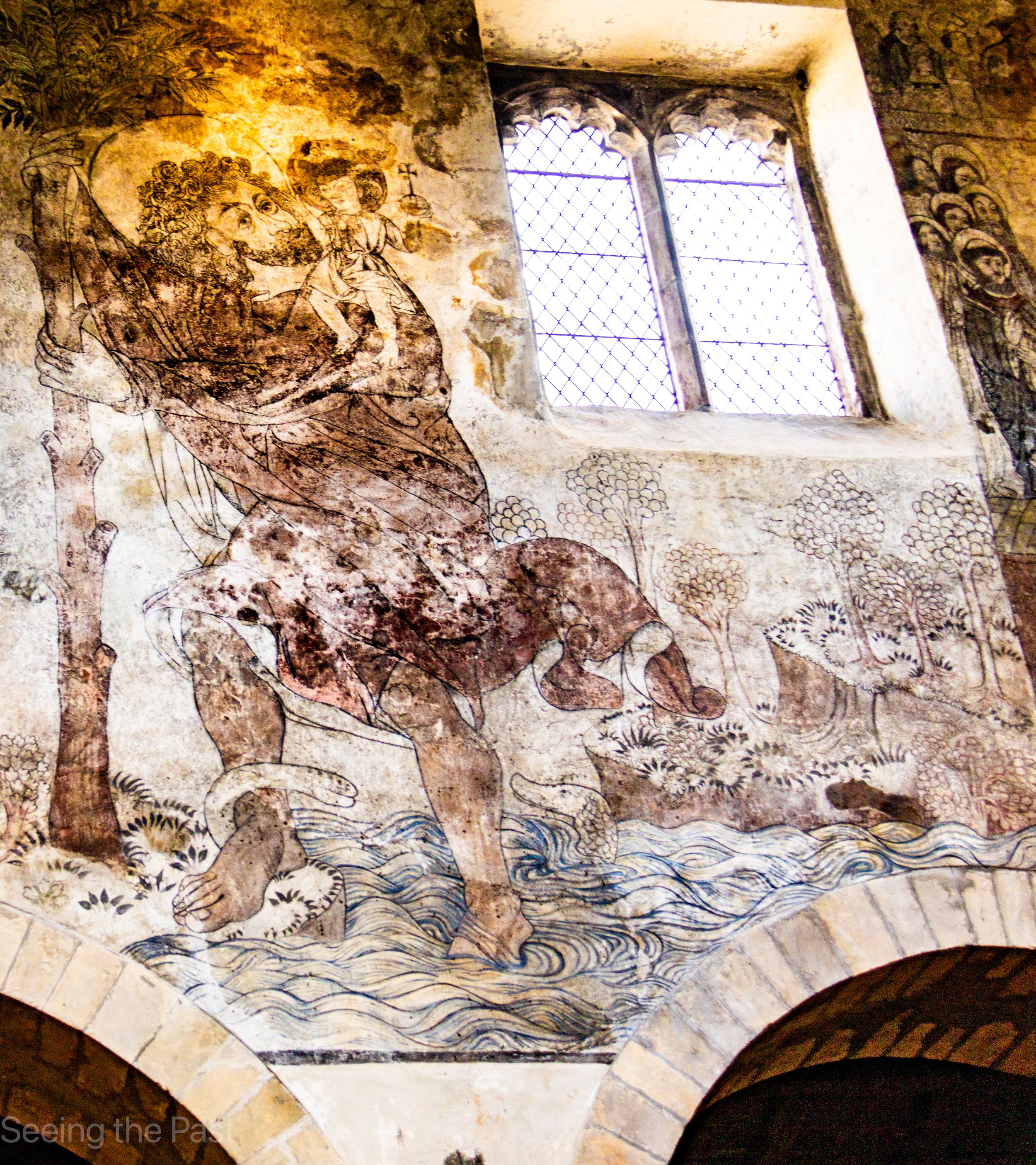
Above St Christopher carry Jesus on his shoulder.
Below An abbot carries a lantern to guide Christopher across the river.
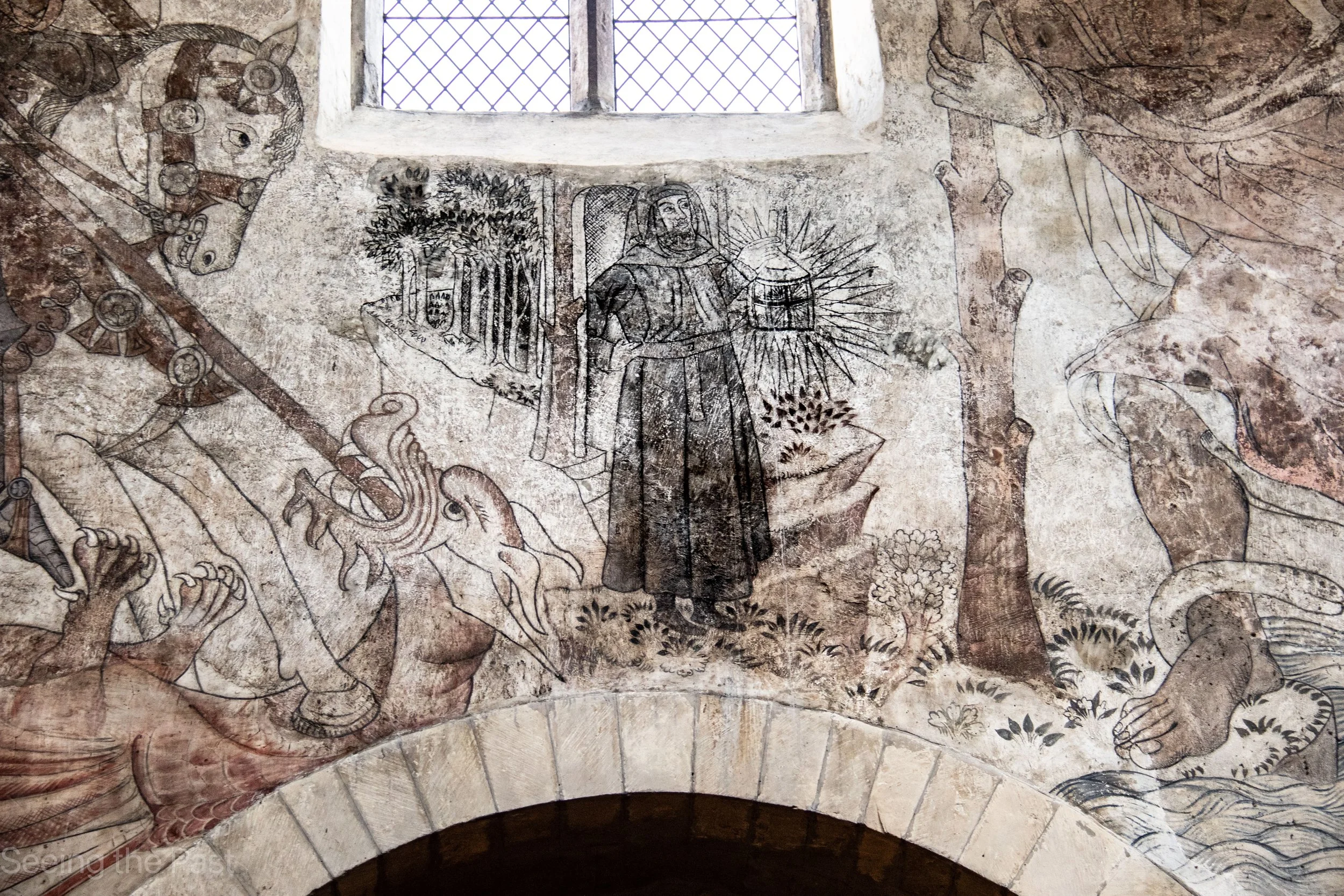
According to “The Oxford Dictionary of Saints”, there is little documented about St Christopher except his death in Asia Minor in the 3rd century AD. Legends in both Greek and Latin began to appear in the 6th century and were added to in the in the 12th century. As the mural above shows, he was a giant of a man who, at first served the Devil but on discovering that the Devil was afraid of Jesus Christ, switched his allegiance to the Son of God. The story goes on to add that he was taught the Christian faith by a hermit and given the job of helping travellers to cross a river safely. At some point, a child asked to be carried across the river but the child was so heavy that Christopher nearly buckled under the weight. On completion the child admitted that he was Jesus and that he carried the weight of the whole world sins. To prove that he was Jesus, Christopher was instructed plant his staff in the ground and the next day it would bear flowers and dates to prove the child was actually Jesus Christ. An alternative version is that an abbot instead of a hermit asked Christopher to carry the child across the river. Carrying the young Jesus across the river resulted in him becoming the patron saint of travellers.
Later on he preached Christianity in the city of Lycia but was was imprisoned when he refused to make sacrifice to the “gods”. This led to him being beaten with iron rods, shot in the eye with an arrow which then healed and so it was decided to behead him. His feast day is 25th July.
St John the Baptist and the Coronation of the Virgin Mary.
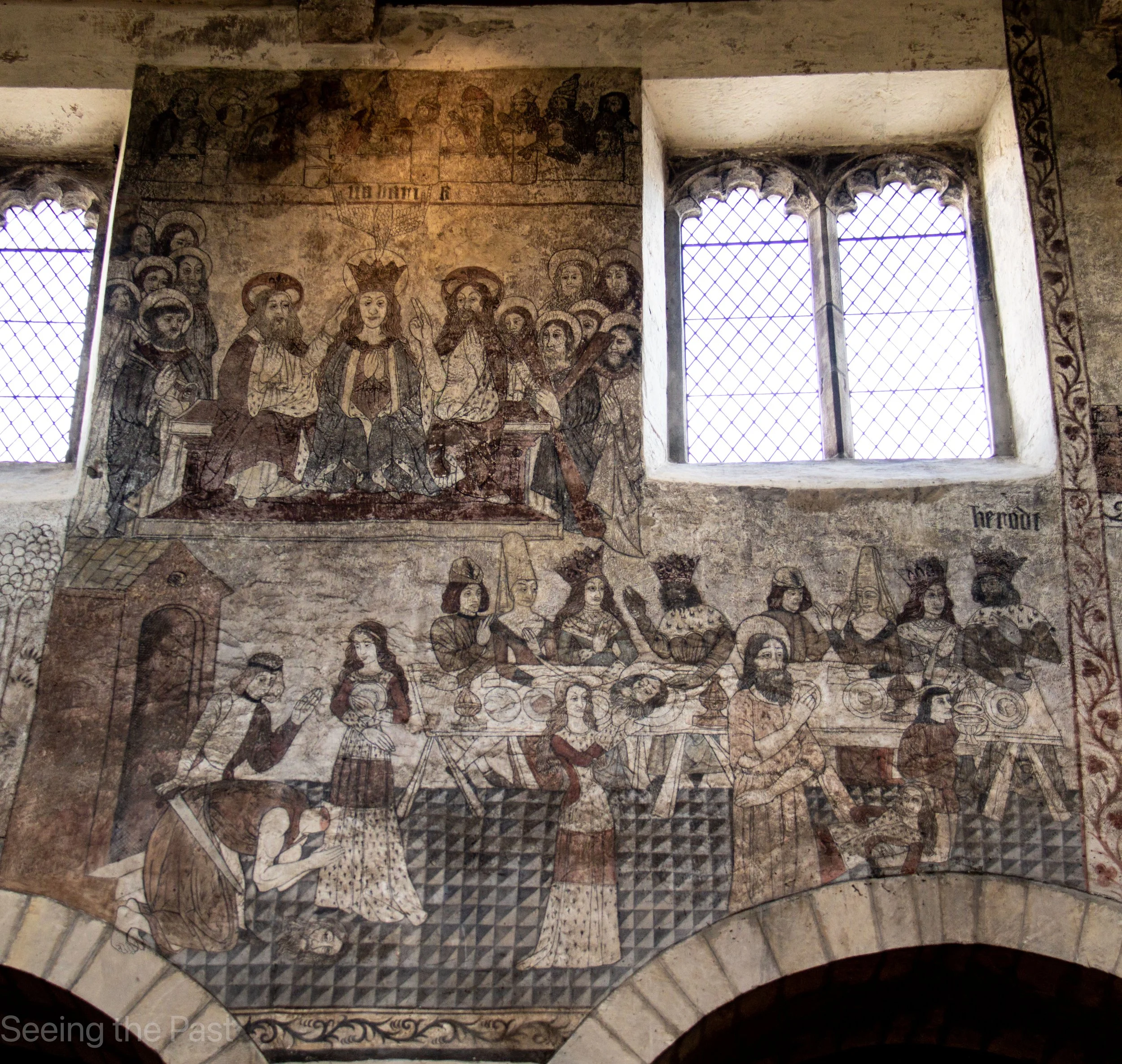
The double mural showing both the Virgin Mary at the top and St John the Baptist underneath.
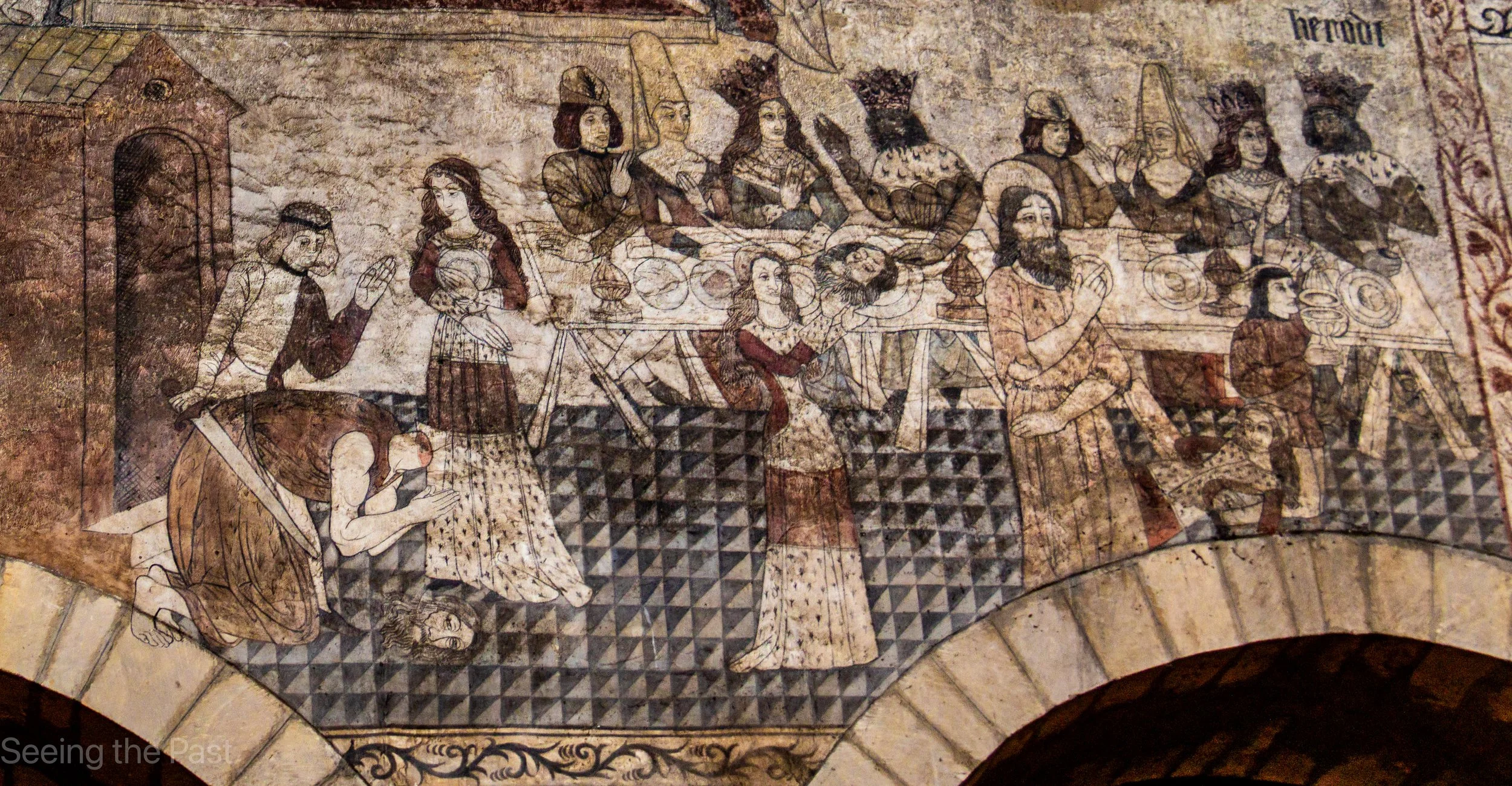
Above, a closeup of what happened to St John the Baptist.
This is a comic strip of what happened, with St John the Baptist being beheaded on the left and Salome dancing in front of King Herod and being rewarded by Herod with John’s head on a plate!
Herod Antipas (20 BCE-after 39 CE) was the son of King Herod The Great and ruler of Galilee. According to various accounts, including two from the disciples, Matthew and Mark, Herod Antipas imprisoned and later executed John the Baptist. This was punishment for publicly condemning Herod’s marriage to Herodias, his half brother’s ex wife, breaking Jewish law and being already married! During a feast, Herod was so impressed by the dancing of Herodias’ daughter, Salome, that he offered to reward her with anything she wished. Having consulted her mother, she asked for John the Baptist’s head on a plate! Salome is shown in the middle, dancing and receiving the head on a plate from the hand of Herod who is sitting on the other side of the table. On the right with a halo, is John the Baptist telling Herod off for marrying Herodias.
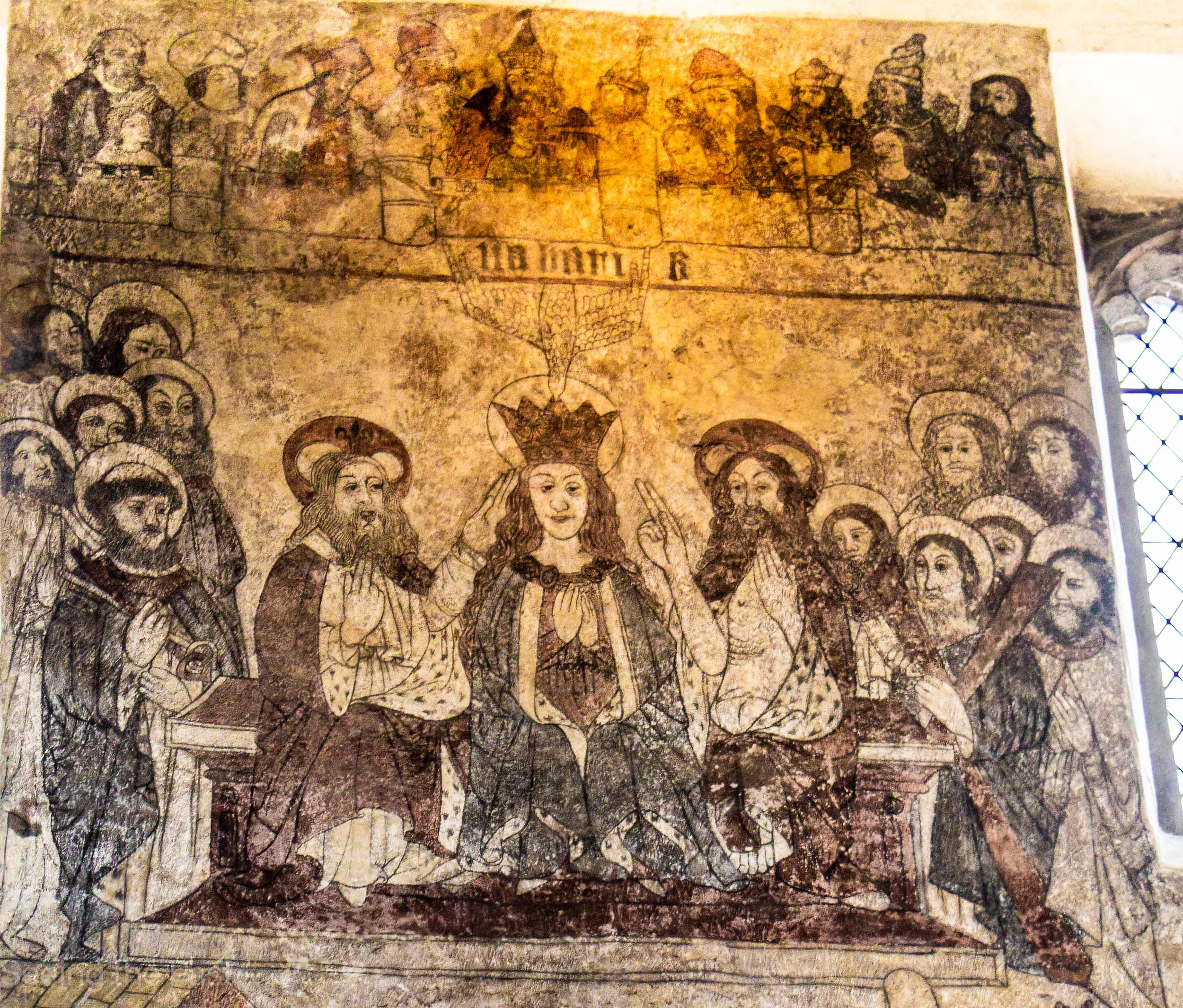
Above, we see the Virgin Mary, Jesus’ mother as “Queen of Heaven”. Either side of her are saints and above her, are angelic musicians and other beings associated with Heaven.
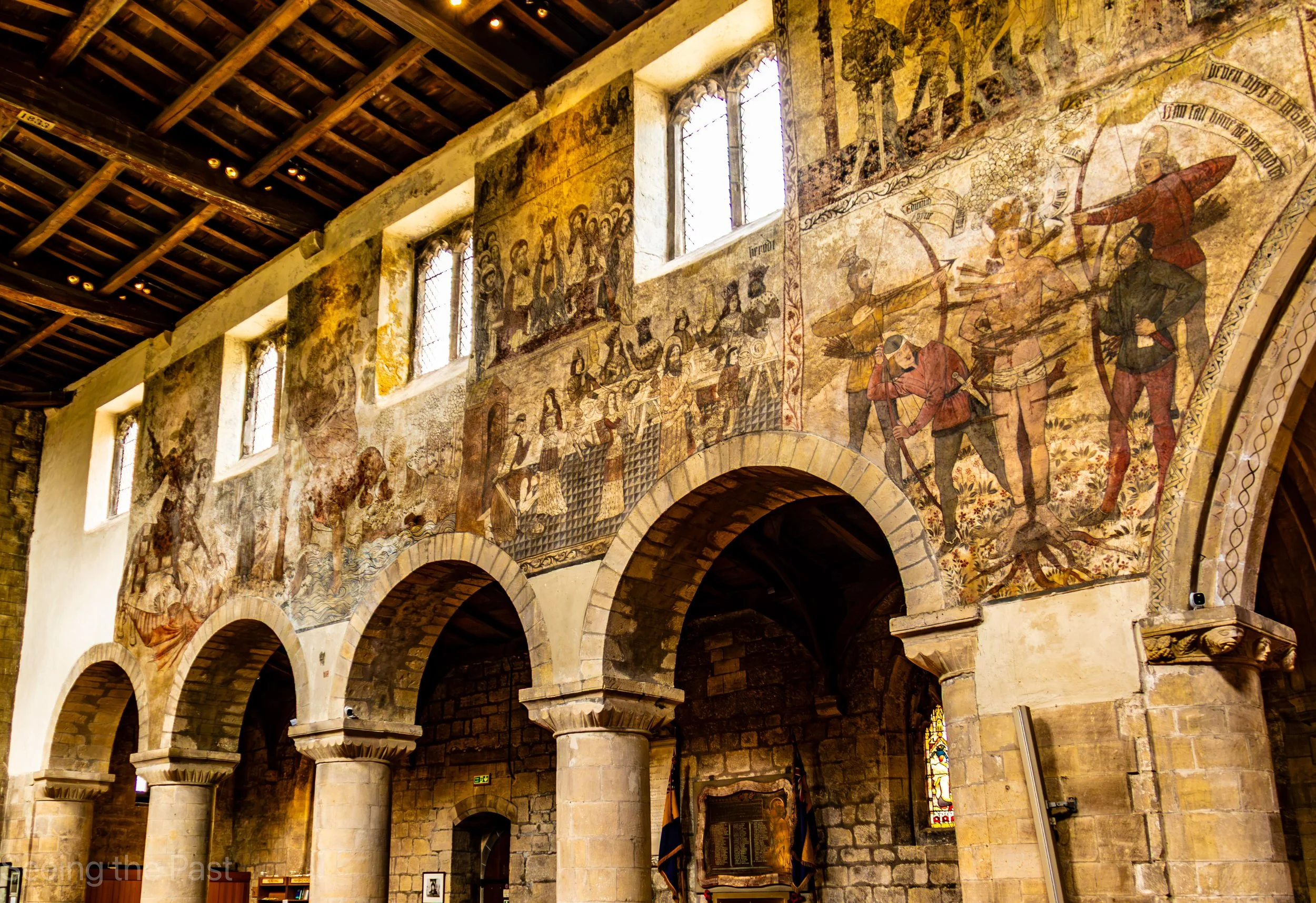
Below, is the execution and martyrdom of St Edmund.
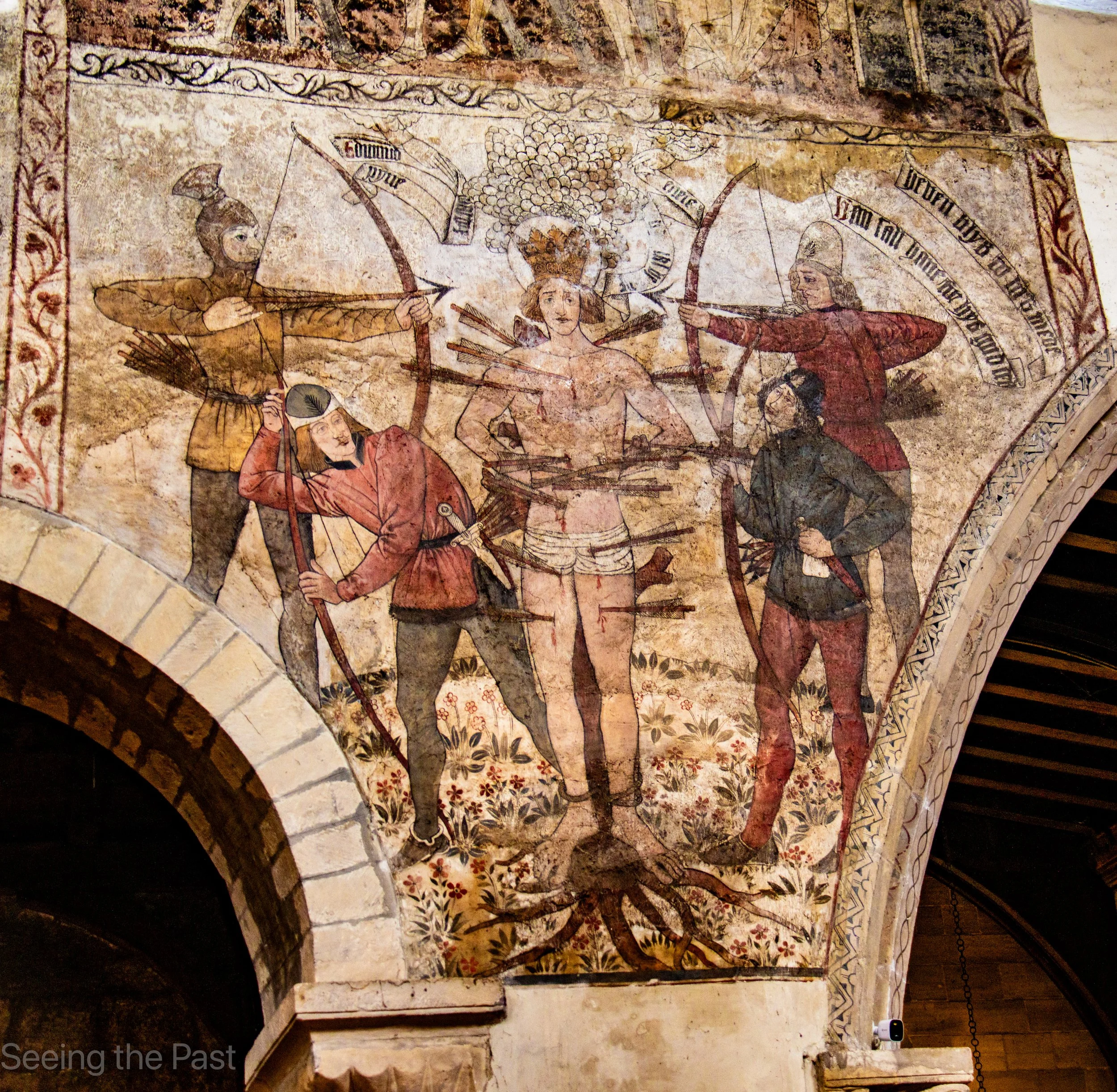
You may have heard of this gentleman when seeing road signs to Bury St Edmunds. Some people I have met actually believe he was the patron saint of England long before St George and should still be today because, unlike St George, he was English and lived in England, whereas St George was Greek and never visited England, as noted in the earlier section on his mural.
St Edmund was born in 841 in the Saxon kingdom of East Anglia and became its king in 865. Unfortunately for him, his kingdom was invaded by “Ingwar “ and “the Viking “Great Army” in 869, who proceeded to defeatEdmund’s army and make Edmund their prisoner. Being courageous he refused to denounce his belief in Christianity and even refused to run EastAnglia as Ingwar’s vassal. What happened next is not totally clear. Tradition states that he was whipped, tied to a tree and then killed by the Vikings who loosed several arrows at him. If that was not enough, finally he was beheaded. Some experts believe that he was “Spread-eagled”, a gruesome traditional viking religous practice. This involves tieing a person up on the ground with their legs spread apart and their arms place apart over their head. Some people add that then their ribs were then spread out under their arms like an eagle’s feathers! In either case, he had a very painful death but did die as a devout Christian. He died at a place called Hellesden and was buried in a wooden chapel nearby. In 915, it was decided to move his body to Bedricsworth a place known as Bury St Edmunds today. However, when they uncovered it, the corpse was found to be “incorrupt” ie it had not decayed. Sometime after this, he became “known” as a saint, “known” rather than made because canonisation by the Catholic Church was not an actual practice until later in the 10th century. His feast day was deemed to be November 20th.
One interesting feature about the mural is the archer at the bottom left. It is thought that when the mural was discovered, the area now occupied by the archer was blank and so the Victorians believed another archer was once there and so painted one in. He certainly seems different from all the other archers.
The martyrdom of St Thomas Becket.
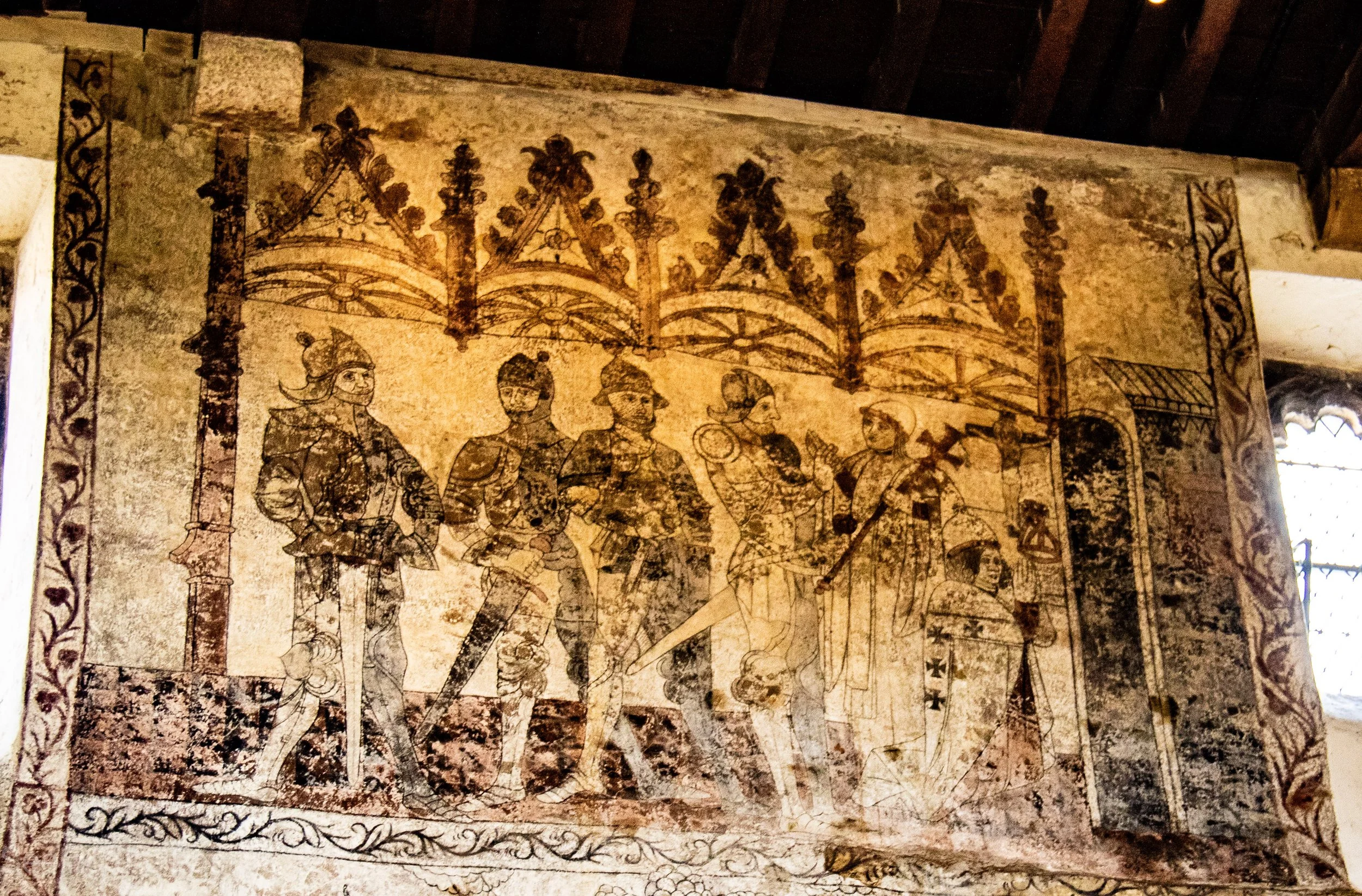
Above on the right of the mural we can see Archbishop Thomas Becket kneeling in prayer whilst four knights are about to behead him. The horrendous murder of an unarmed servant of God quickly resulted in Becket becoming a hero and a saint, whilst King Henry II of England became an evil murderer.
Henry II’s predecessors had an issue with the Pope and the church which came to the fore in his reign and again under Henry’s son, King John. Early in Henry’s reign, the Archbishop of Canterbury died and Henry asked his chancellor and friend, Thomas Becket to be the next Archbishop. Henry would then get Becket to agree to reduce the power of the church and see the King as the ruler of England in every aspect. The issue was, who had ultimate power in England?Henry was annoyed with the system of Church courts which replaced his courts where a member of the church was involved. As long as someone could read a section of the Bible or pretend to read by reciting a section from the Bible, they could claim that they were associated with the church and get a lesser punishment than they would receive in one of Henry’s courts. Two people committing the same crime would not get the same punishment if one could show that he was a member of the church.
Unfortunately for Henry, his plan was a complete failure with Becket supporting the church and opposing all of the king’s reforms. At one stage Becket believed he was in danger and so fled to France but whilst there, Henry managed to upset him. This time Henry wanted to have his son, Prince Henry crowned so that he could be king when his father died, without any challengers. To enable this to happen an archbishop was needed but with Becket in France, the Archbishop of York performed the ceremony. This infuriated Becket to the extent that when Becket returned to England, he took action against the Archbishop of York and those bishops who assisted him. On hearing this whilst at Falaise castle in France, Henry may have said “ who will rid me of this troublesome (or turbulent) priest?”. However ,did he literally mean what he said or was he extremely frustrated? Thinking about it, how many people say in jest, “I’m going to kill you” when they are simply upset and do not mean it literally. Did Henry mean what he said or was he hoping some people might take this as a royal request? Either way, four knights heard him and rode quickly to the French coast where they boarded a boat bound for England.
Once at Canterbury they violently attacked Becket and sadly he died. A few people have suggested that Becket did nothing to stop them and wished to be a martyr like so many saints associated with the church. He did not bolt the door to stop them entering, use his crozier for defence or even hold his arm up to prevent the blows hitting his head. This theory is rather extreme but there are so many questionable parts to the story of Becket’s death. Firstly, did Henry actually say those words? Secondly, why did the Knights take his words to mean that he really wanted Becket executed. Furthermore, why did they do it? To murder an archbishop was a very serious crime that would definitely not get them a royal reward which, if they were caught, their dreadful actions would result in a slow and extremely painful death!
St Catherine’s path to becoming a saint
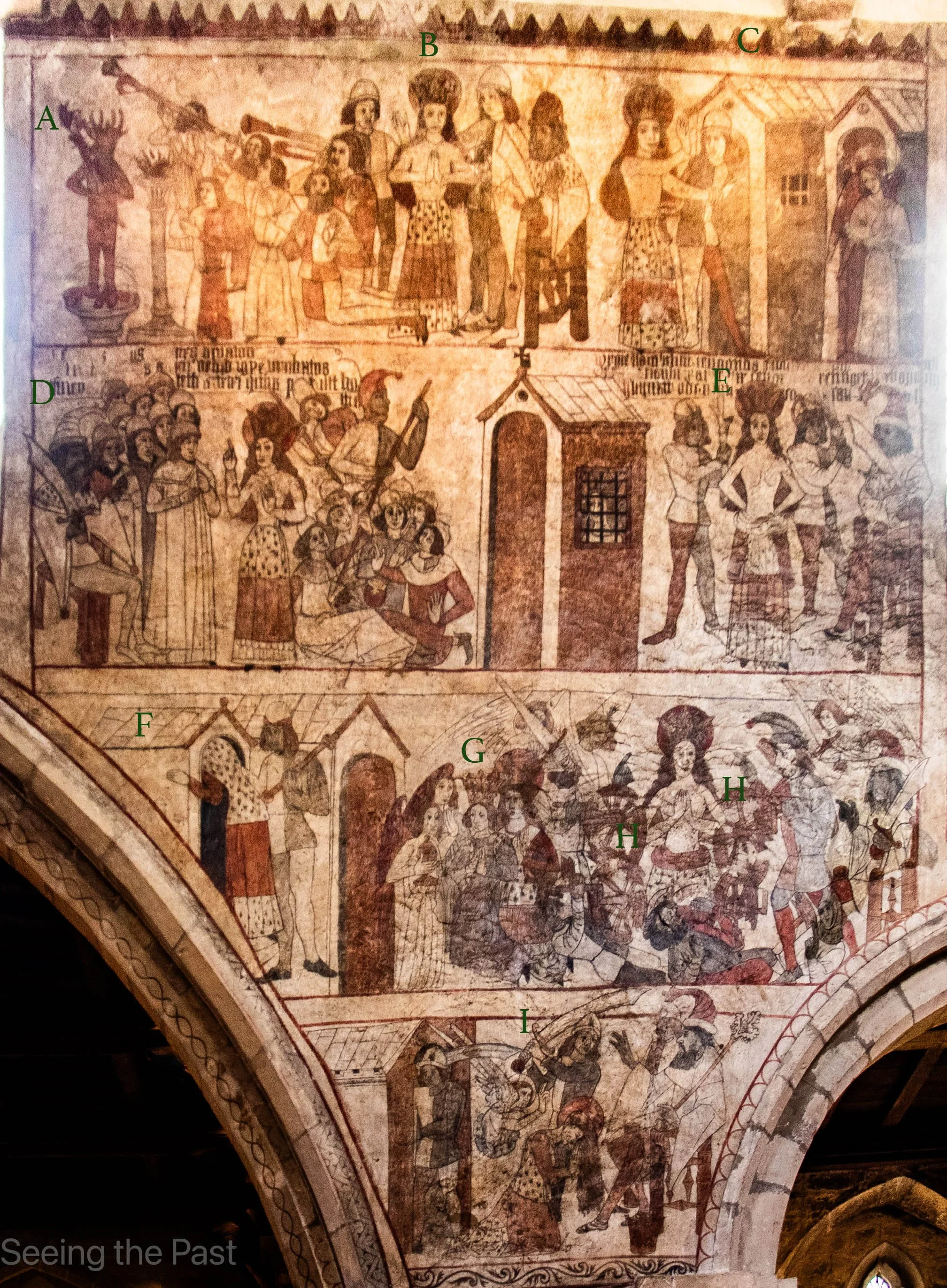
In the time of Emperor Maximian (Maxentius) 286-305, Catherine had a vision, of the Virgin Mary who went on to persuade her to be a christian. In the painting A at the top shows the emperor worshipping an idol with B showing Catherine protesting against what he is doing.To the right is C which shows Catherine being put in prison.
In the second section, D shows Catherine discussing religion with the Emperor’s philosophers with the results that they are converted to Christianity! To the right is E where the philosophers are excited and Catherine is whipped.
In the third section D shows Catherine being sent back to prison and in G she is visited by the Empress Faustina who Catherine also converts to Christianity. She too is executed and in H, Catherine is tortured on a spiked wheel. However, when she touched it, the wheel shattered and so she ended up being beheaded in I. She was martyred at the age of 18 and apparently, as a saint, appeared to Joan of Arc 1100 years later.
The seven “Corporal Acts of Mercy”.
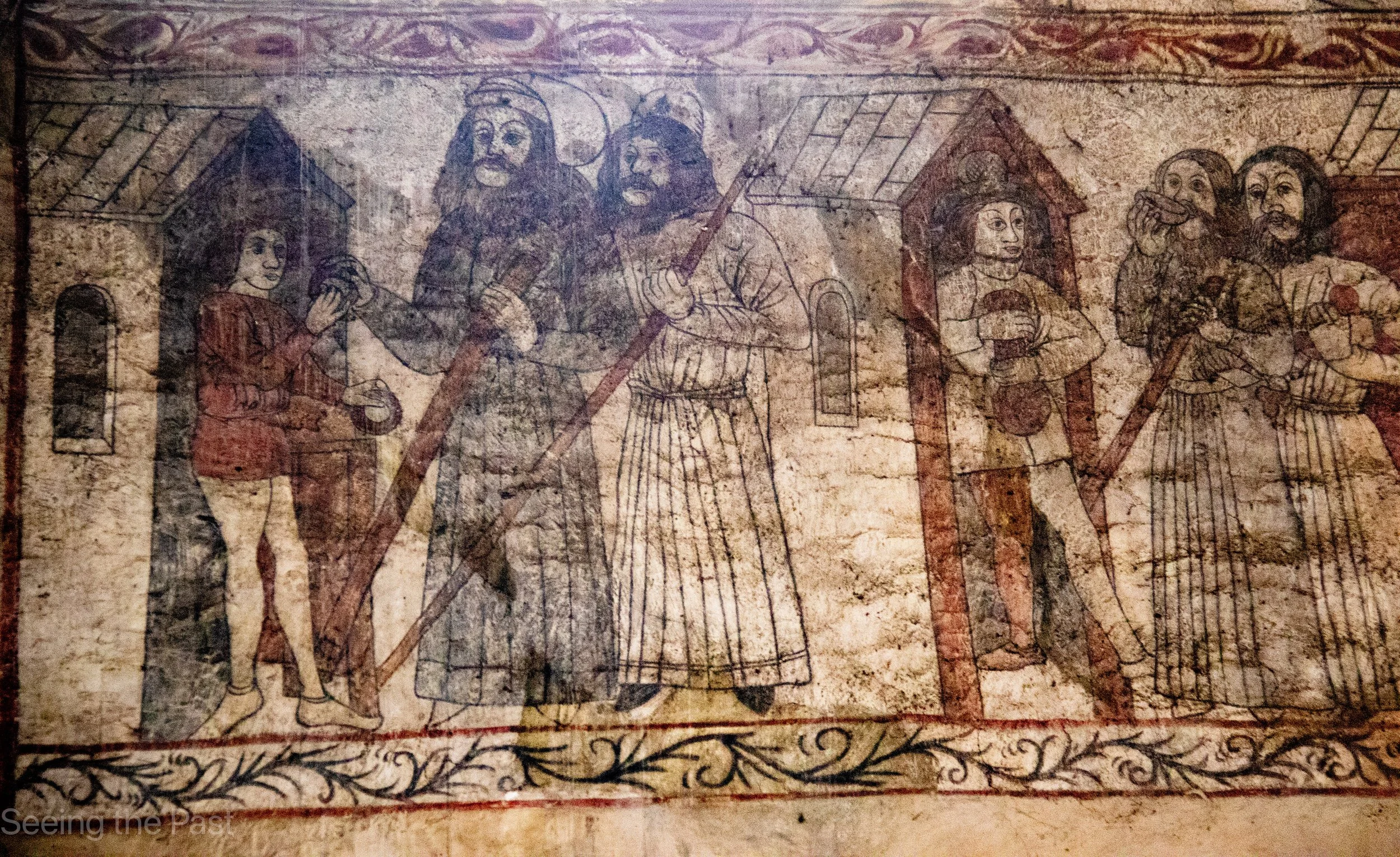
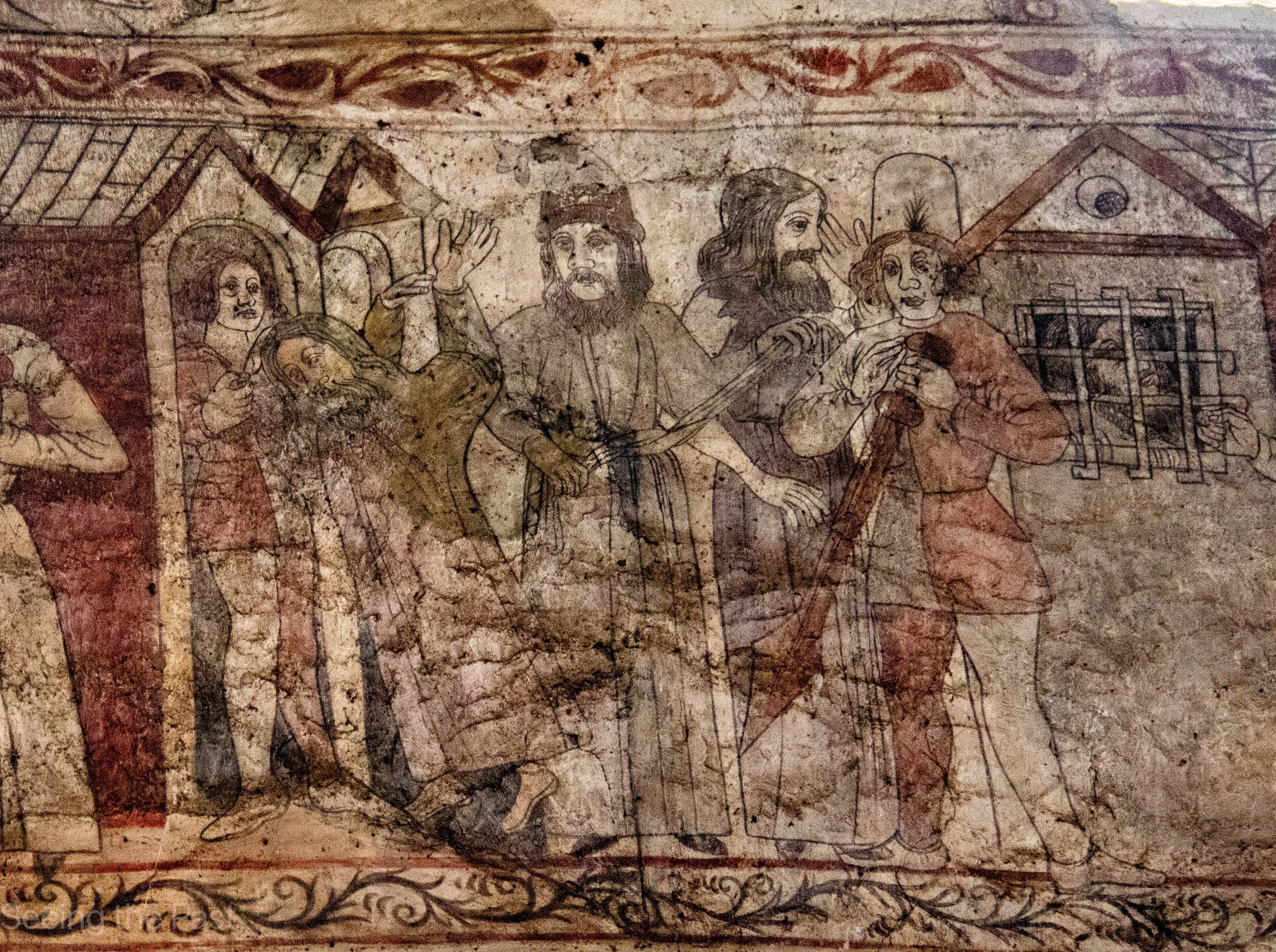
In simple terms, these are traditional things Christians should do to relieve others of physical (bodily) suffering. The word “corporal” comes from the latin corpus meaning body. The first part of the mural below shows on the left, to feed the hungry or poor and on the right to give drink to the thirsty.
The next acts refer to the duty to shelter strangers and clothe the naked.
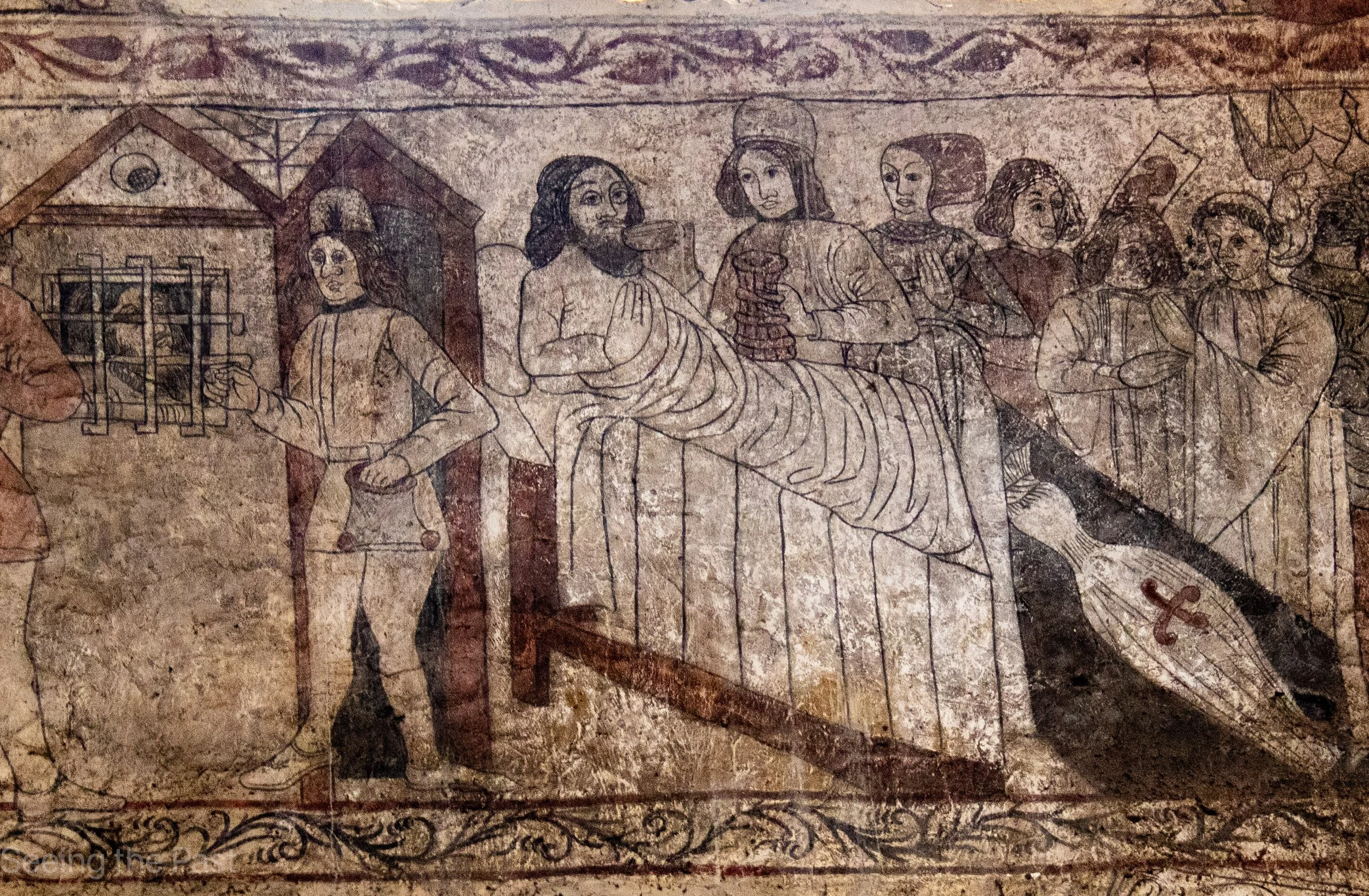
Below the last three are to visit people in prison, to tend to the sick and to bury the dead.
The next series of murals refers to the “Passion” and Jusus’s Crucifixion at Easter. The “Passio” comes from the latin word “Passio” which means suffering or enduring and refers to all the suffering Jesus has to endure before enduring the horrific pain of crucifixion ie being nailed to a cross whilst still alive.
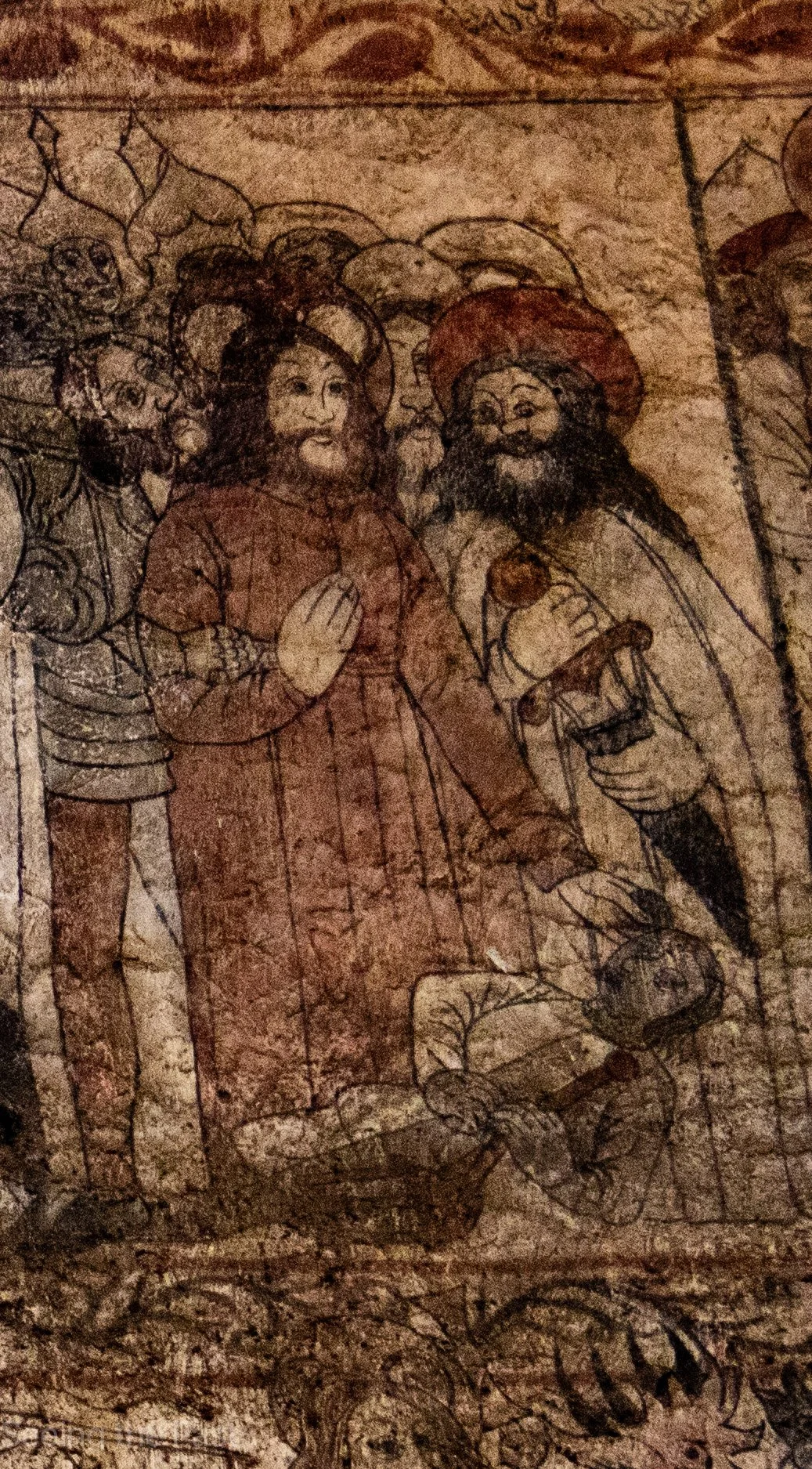
Above, when temple guards come to arrest Jesus in the Garden of Gethsemane, Peter (a disciple of Jesus) drew his sword to defend Jesus and chopped off the ear of the high priests servant known as Malchus. Jesus was not happy with this, told Peter off and healed Malchus’s ear.
Below; the temple guards take Jesus to the Roman Governor, Pontius Pilate who orders Jesus to be whipped. His crime is that he claimed to be the Messiah and to be the King of the Jews which was a threat to Roman rule.
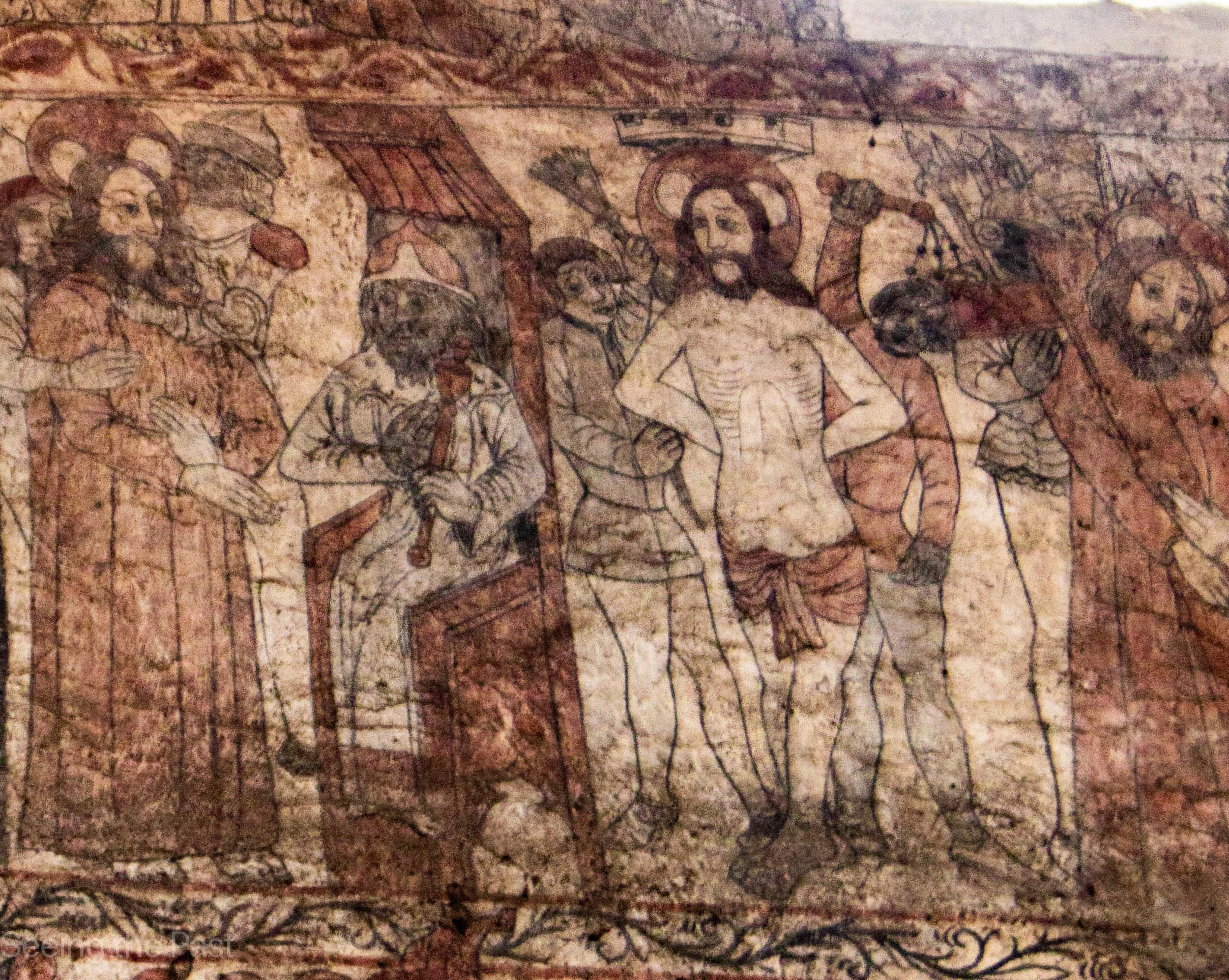
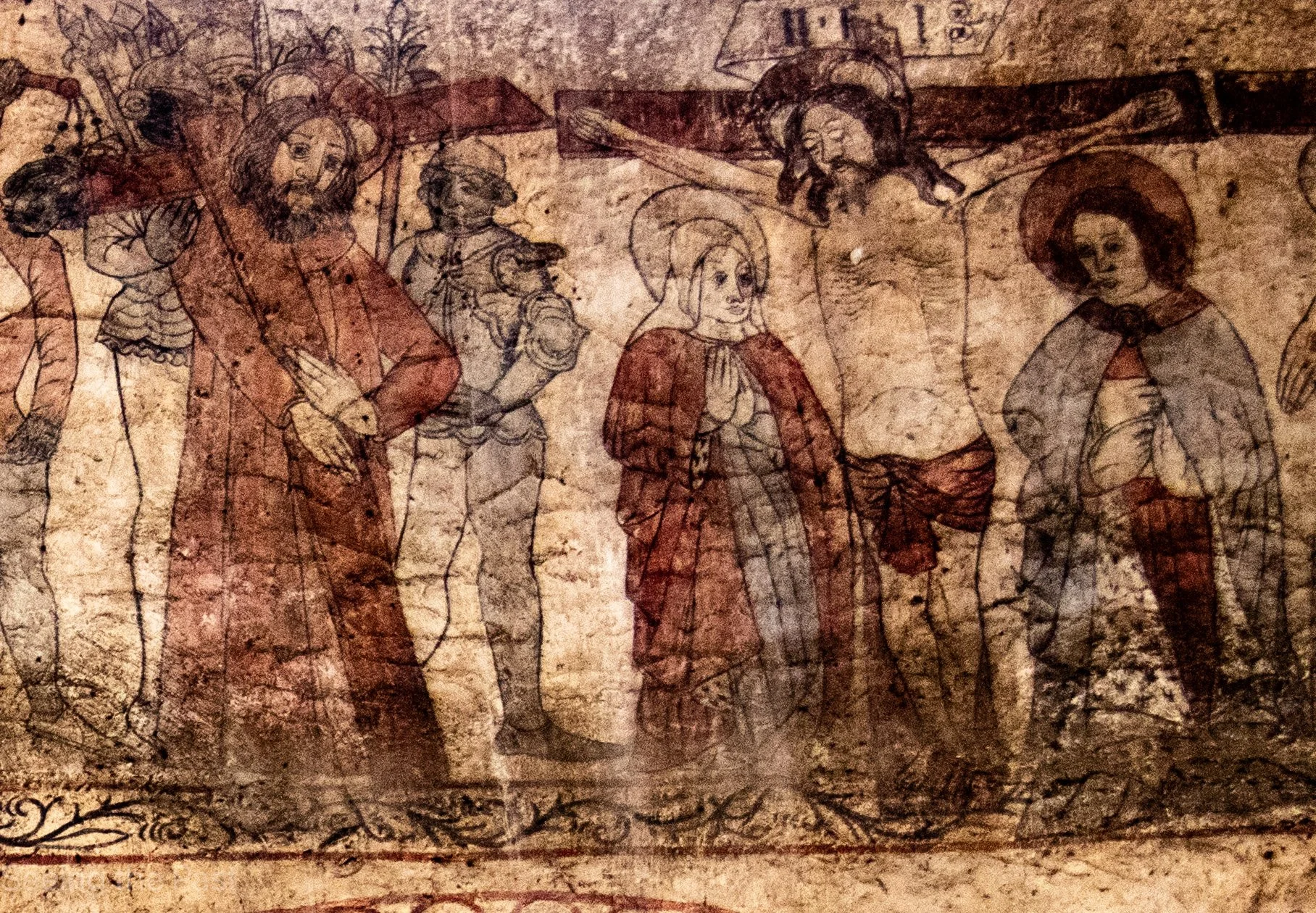
Pilate also ordered that Jesus had to carry a large cross to Calgary on which he was then crucified.
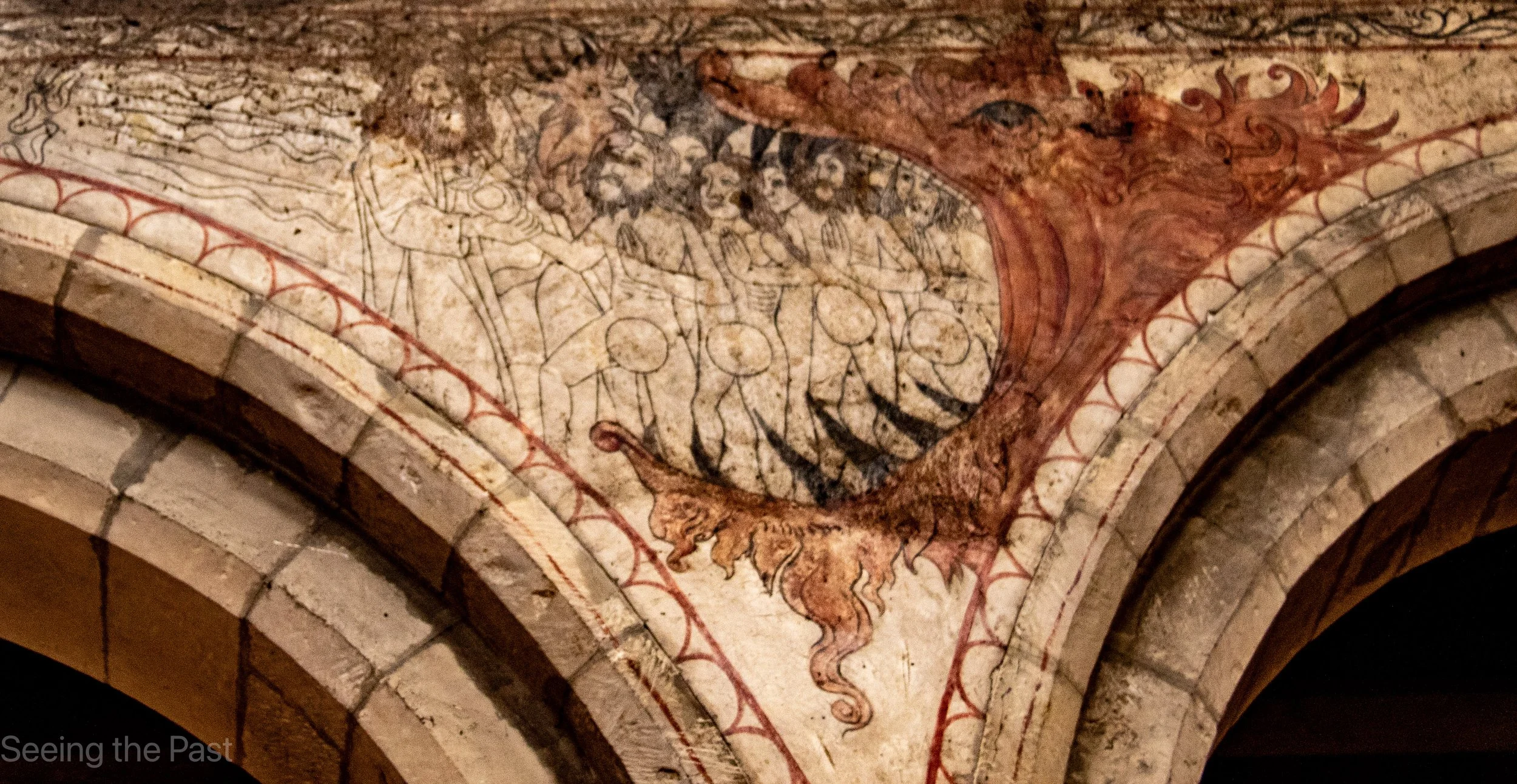
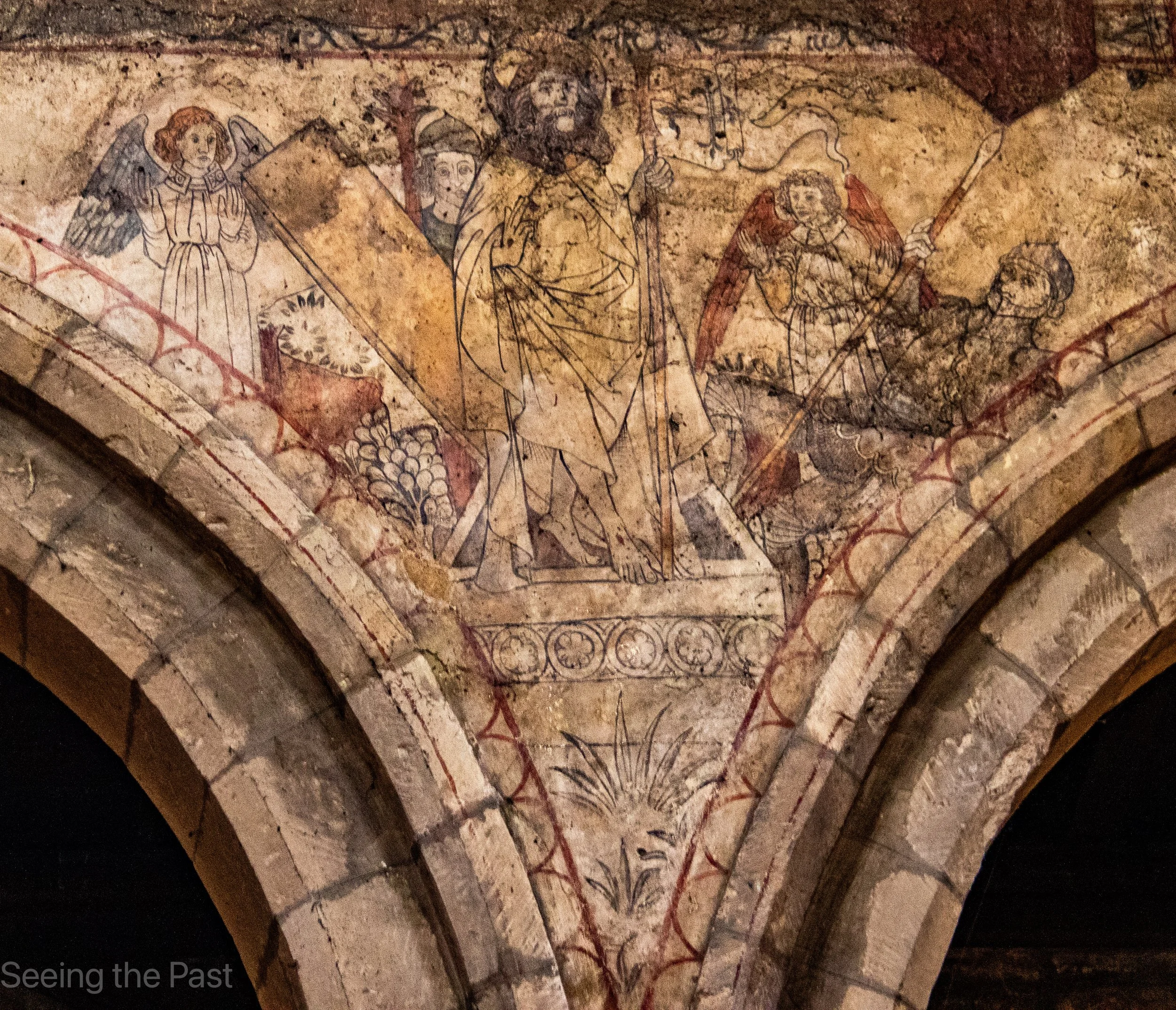
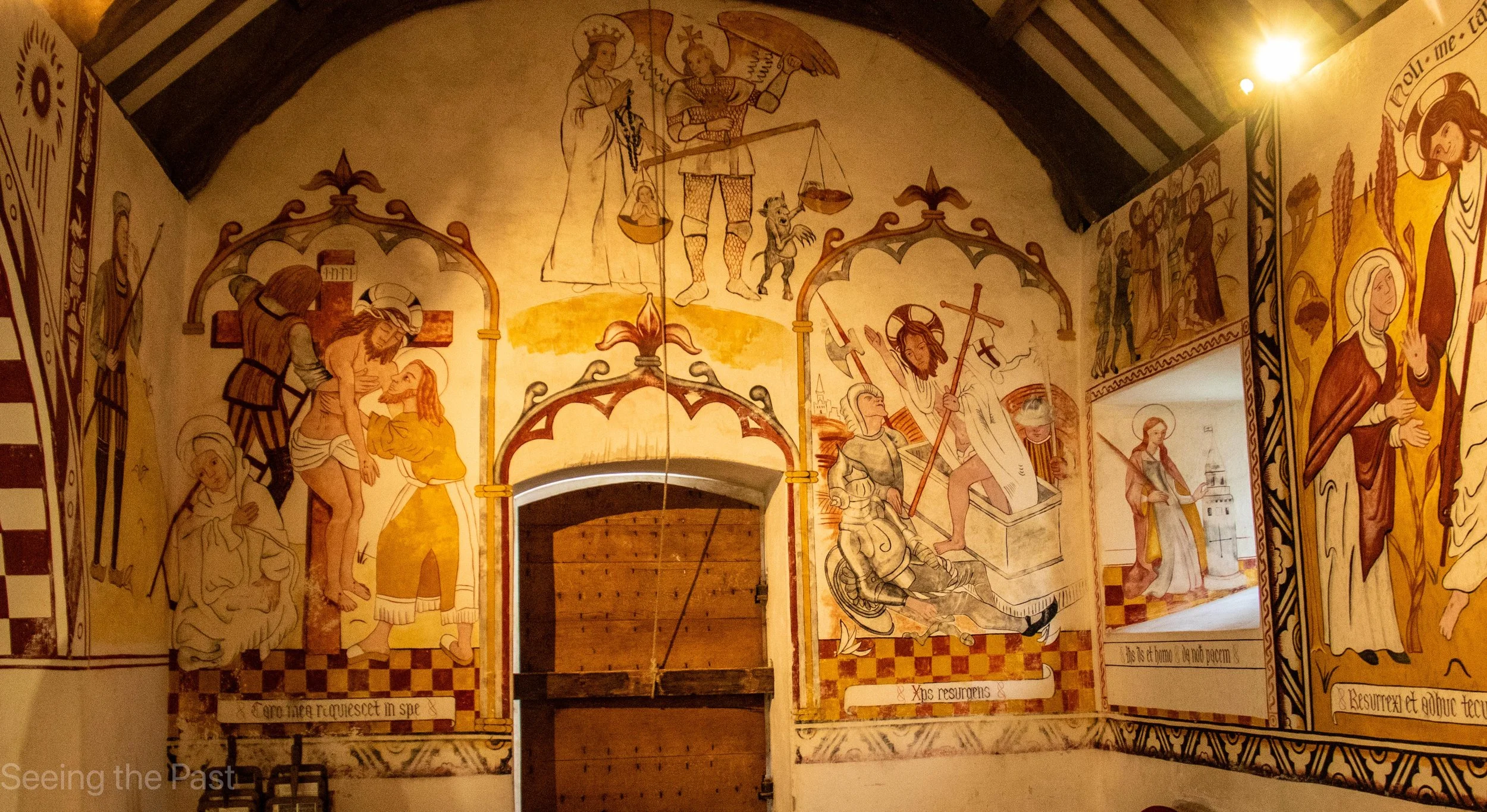
Below; Jesus’ decent into Hell before his resurrection. Here we see a dragon’s mouth to represent Hell with the Devil and one of his agents with spiky heads! There are a number of interpretations with regards to what happened and some even state that Jesus did not go to visit Hell! One view is that the gates to Heaven were closed until Jesus had completed his sacrifice on the cross. He was now to go to Hell and take people who had lived before him such as Abraham, Moses and David to Heaven after he was resurrected. If you look closely you can see that the first soul to meet Jesus was holding a circular object and this was Adam with an Apple who was closely followed by Eve.
Below. After Jesus visited Hell, he was resurrected. On the right is a soldier falling backwards , amazed to see Jesus rising out of the ground en route to Heaven with two angels, one to the left and one to the right.
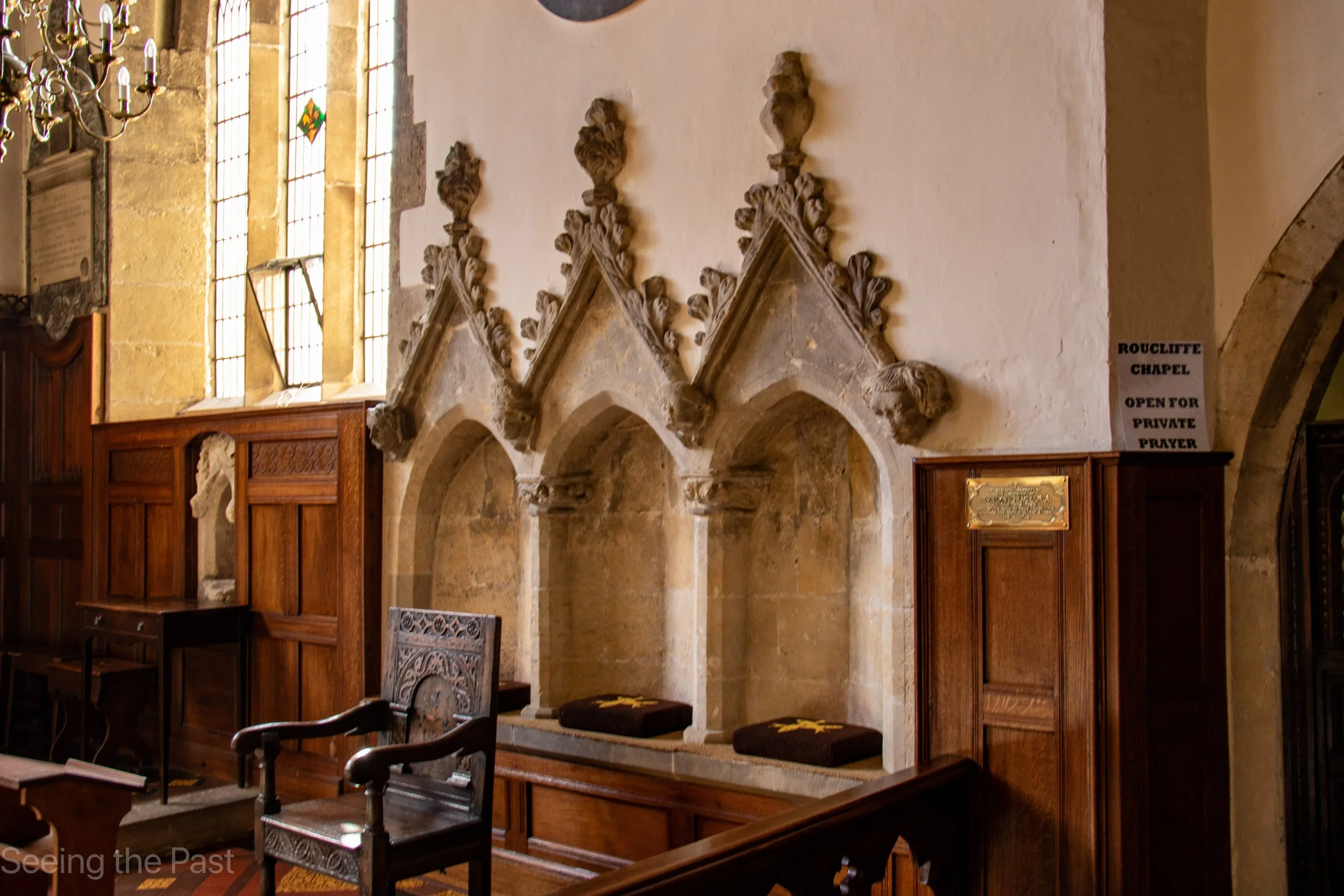
Some other interesting features of the church.
Below is the “Sedilia”, a latin word which simply means seats or benches for the priest.
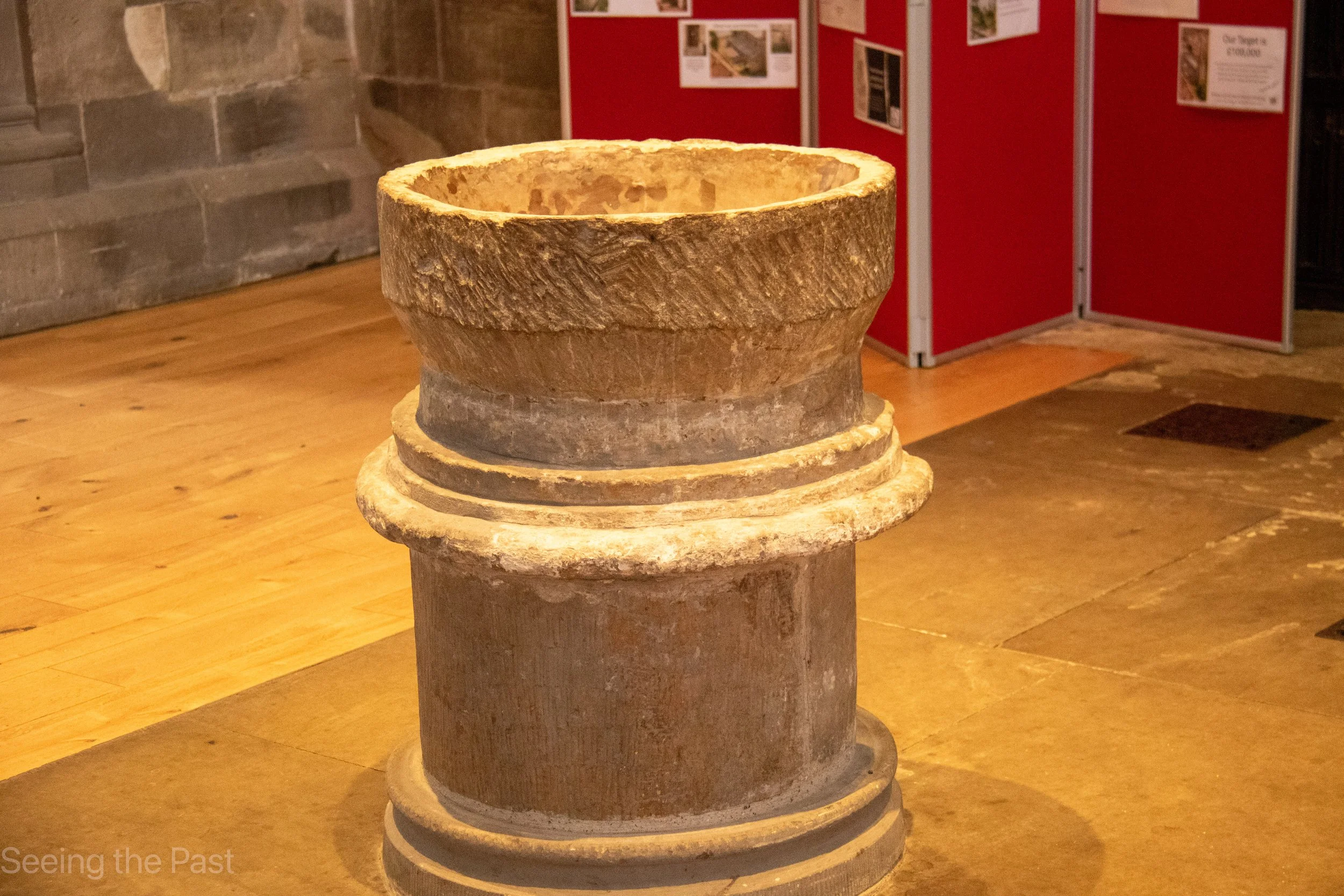
Below is the font where people are baptised. The top half of it is believed to be Saxon in origin and so over 1000 years old!
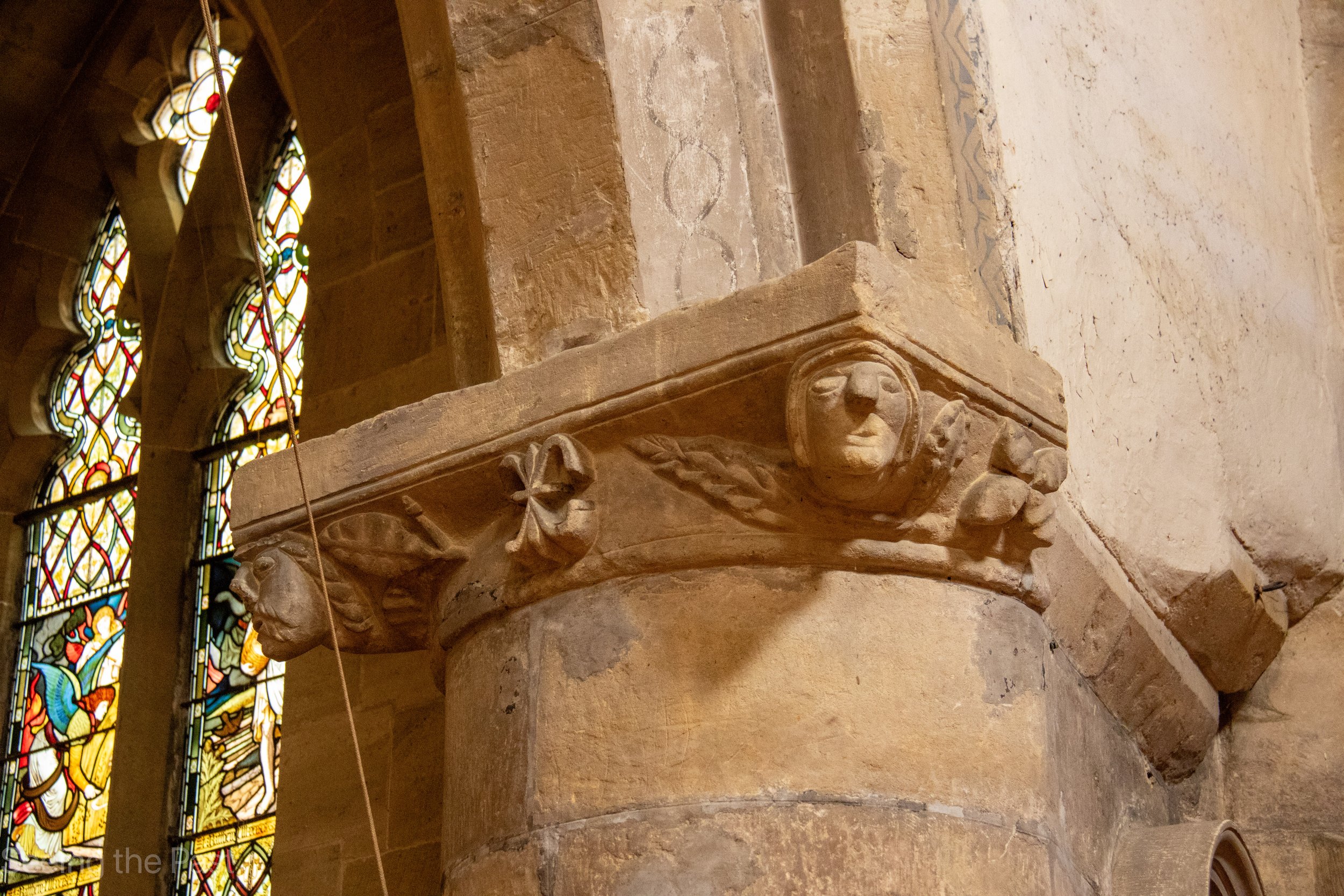
Below, there are some interesting grotesques to see but not the type that will give you nightmares.
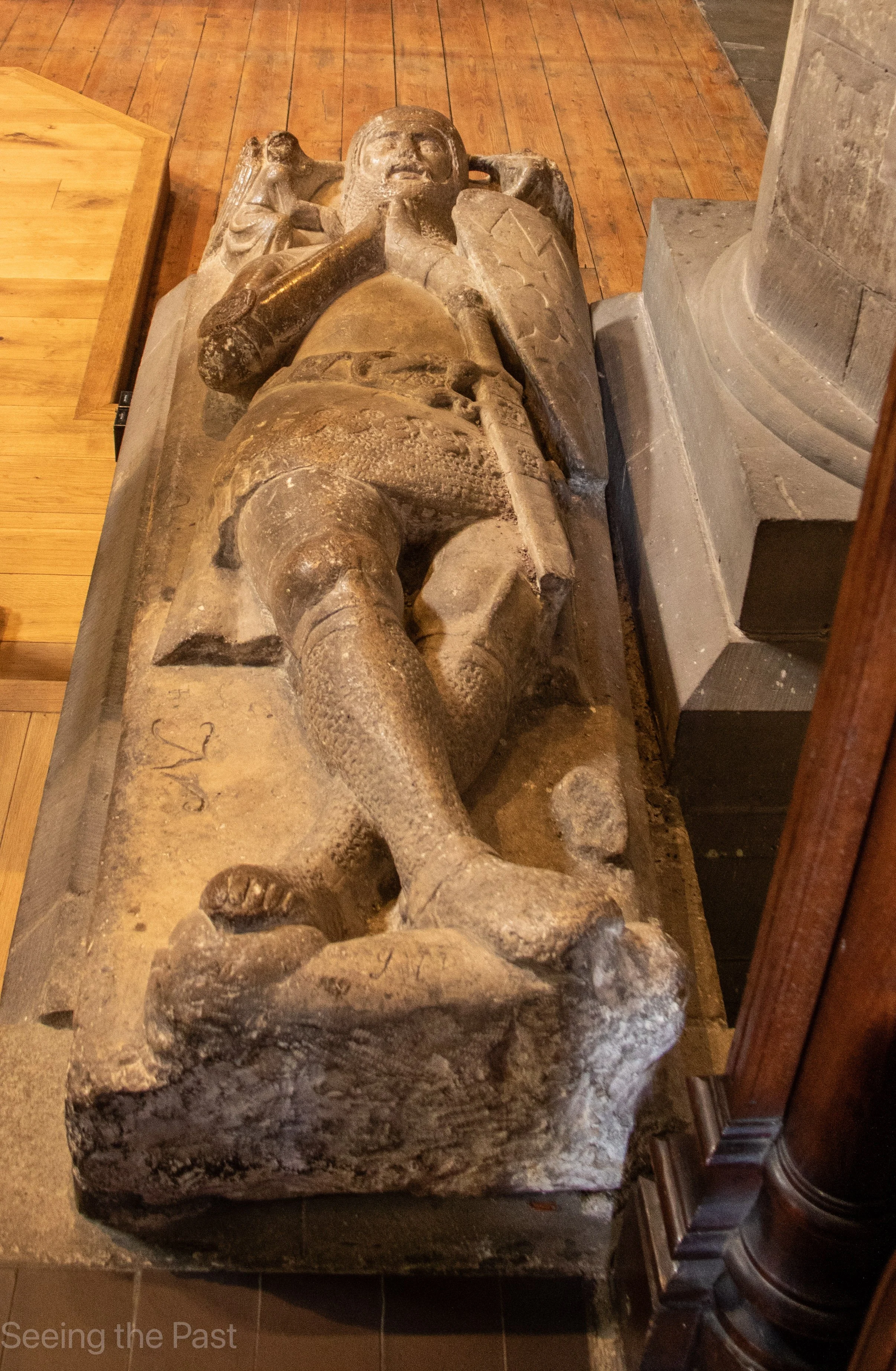
Below, the effigy of Sir William Bruce wearing plate armour from the period 1340-50,
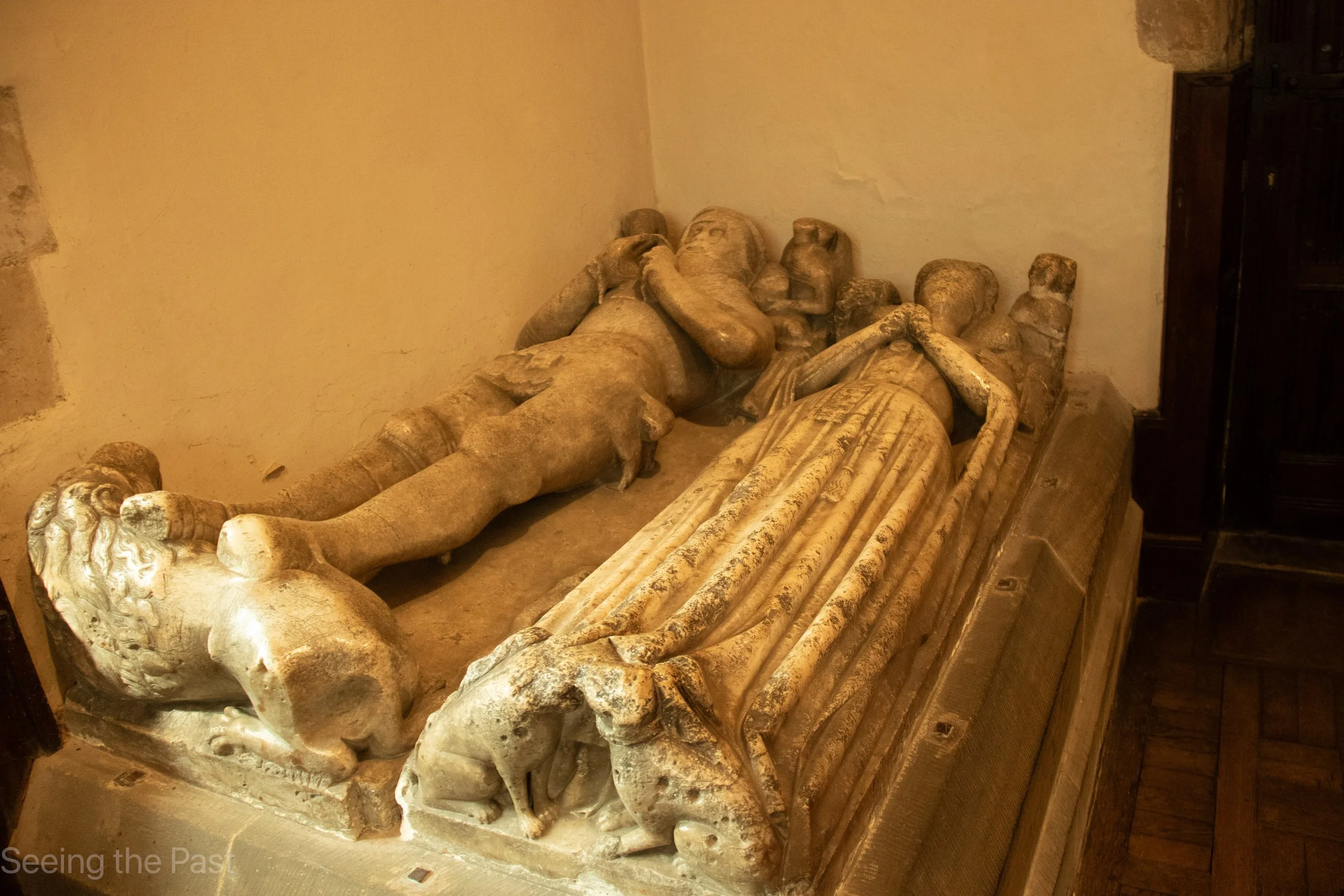
Below the effigies of Sir David and Dame Margery Roucliffe from the late 14th and early 15th centuries. They were married in 1393 but sadly, Sir David died only 14 years later without having any children.
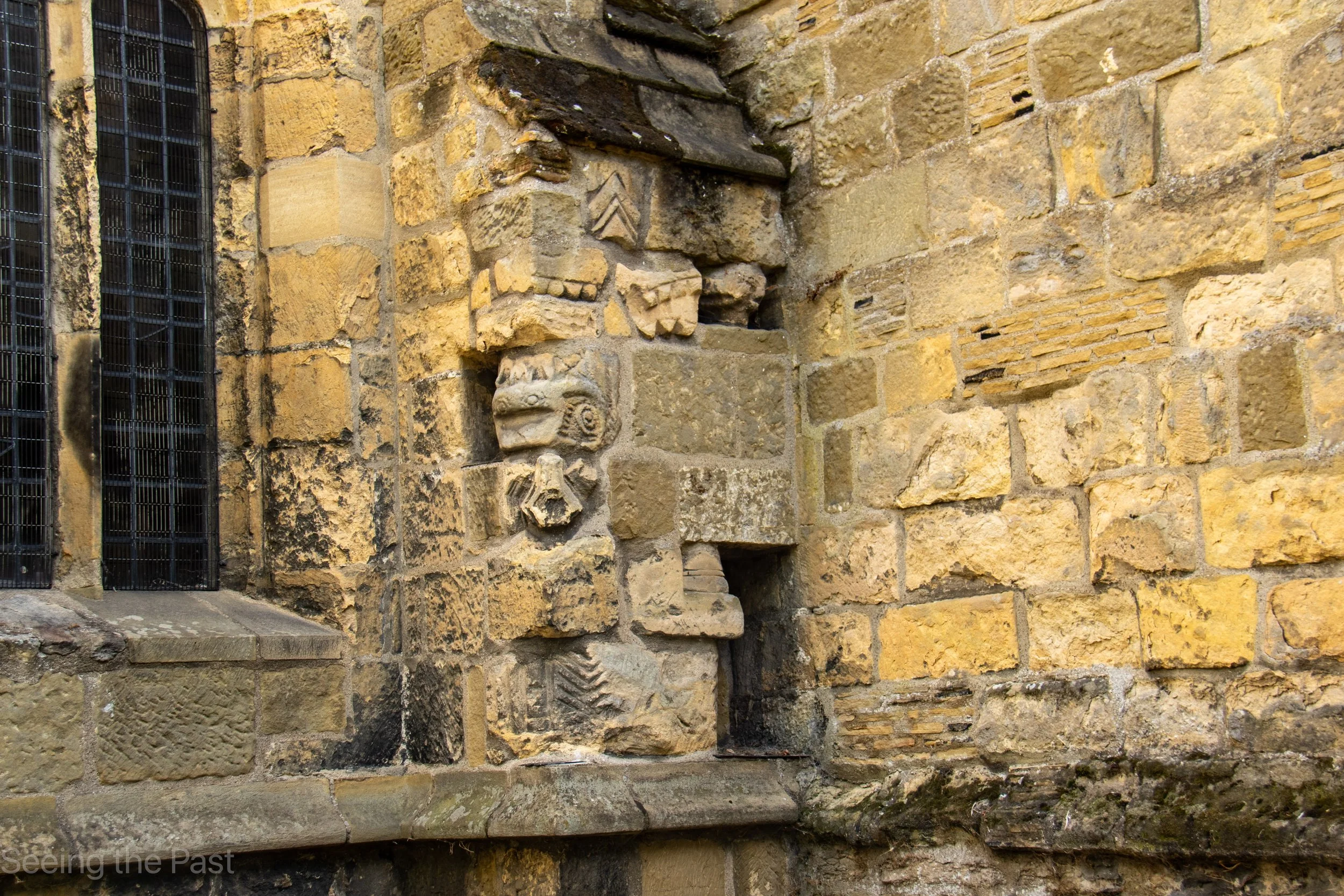
On my way to the entrance I noticed some fascinating “recycled” stone carvings which formed part of the exterior wall of the church.
Essential Information.
Location;Address: Hall Garth, Pickering, North Yorkshire, YO18 7AW
Parking. There is a car park in Pickering about 10 minutes from the church and some parking at the side of roads. However, in the summer months I advise you to get there fairly early because a lot of the parking spaces are taken up by visitors to the North Yorkshire Moors Railway. A popular steam railway travelling along some beautiful scenery. You could, of course, do both the train and the church.
Opening hours can be found on the website https://www.pickeringchurch.com in the section “Welcome to our Church”.
Articles that might interest you.

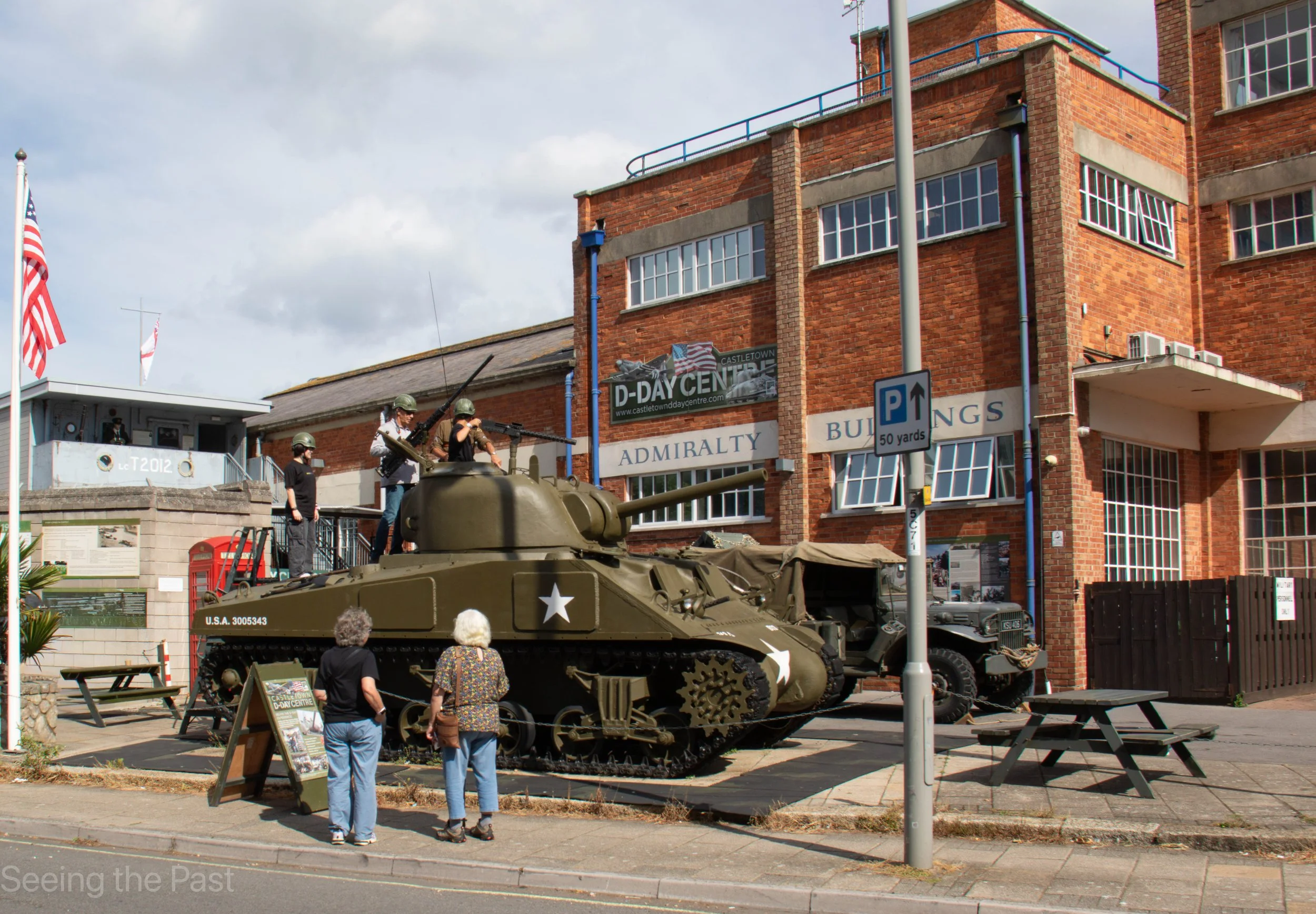



Tucked away in Isle of Portland in Dorset, the Castleton D Day Centre offers a powerful and immersive window into one of the most significant moments of the Second World War. Far from being a traditional “look but don’t touch” museum, the centre invites visitors to step closer to history — with a remarkable collection of authentic artefacts that can be touched, held, and even sat on, bringing the realities of the D-Day era vividly to life. Added to this are several friendly volunteers dressed in period outfits who have a vast amount of knowledge of those artefacts and are able to answer questions.